

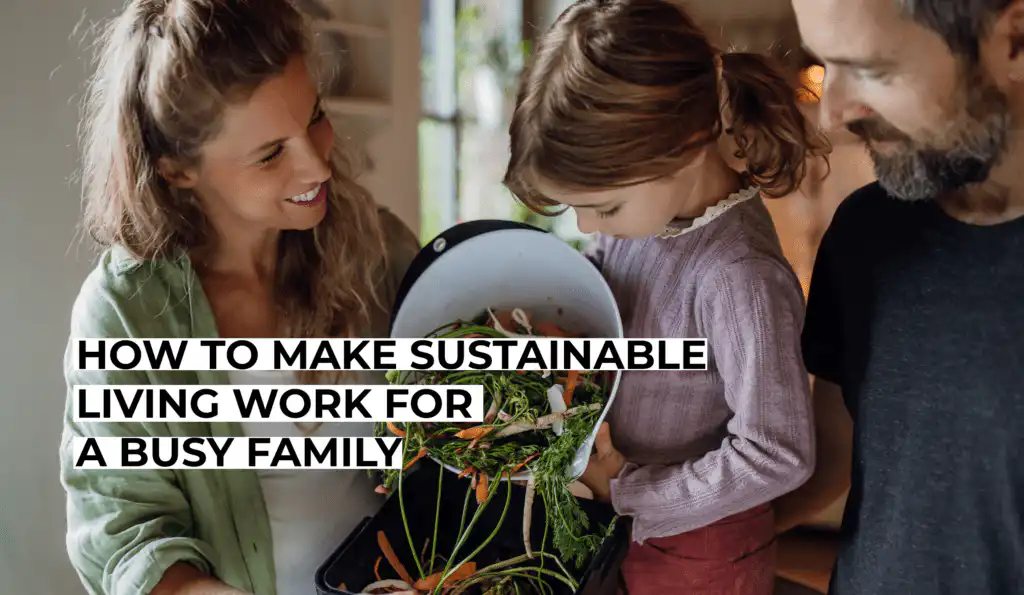
How to Make Sustainable Living Work for a Busy Family
[et_pb_section fb_built=”1″ _builder_version=”4.16″ _module_preset=”default” global_colors_info=”{}”][et_pb_row _builder_version=”4.16″ _module_preset=”default” custom_padding=”|||14px||” global_colors_info=”{}”][et_pb_column type=”4_4″ _builder_version=”4.16″ _module_preset=”default” global_colors_info=”{}”][et_pb_text _builder_version=”4.27.5″ _module_preset=”default” custom_padding=”9px|24px|24px|23px||” hover_enabled=”0″ global_colors_info=”{}” sticky_enabled=”0″]
How to Make Sustainable Living Work for a Busy Family
Busy families often worry that green living means more effort, more time and more stress. Sustainability doesn’t have to be a burden, though. With a few practical, easy-to-implement habits, you can build an eco-friendly lifestyle that fits your family’s rhythm, saves money, and sets a positive example for the next generation.
Start with Small, Everyday Changes
Big environmental goals can feel overwhelming, but the impact of sustainability starts small. Simple habits like cutting down on single-use plastics, using reusable containers and water bottles, and cooking only what you need can significantly reduce waste. For example, families can plan weekly meal menus to avoid overbuying, store leftovers properly, and reuse containers instead of tossing them out. Such small actions don’t demand any extra time and require very little effort. Indeed, they can actually save time, as meal planning avoids last-minute shopping trips, and reusing containers avoids unnecessary packaging and waste. Over time, these changes become habits, turning “trying to live sustainably” into “just how we live.”
Make Transport Choices That Work for You
Transportation is a major contributor to household carbon footprints. That’s why choosing greener travel options can make a substantial difference. Electric vehicles, for example, are generally much cheaper to run than petrol or diesel cars, thanks to lower fuel (electricity) costs, reduced maintenance demands, and fewer emissions. For many families, it’s about balancing cost, practicality and environmental responsibility, but even if you aren’t quite sold on electric, shopping for used cars instead can be a smart and affordable way to go green in a way you are happier with for now.
[/et_pb_text][et_pb_image src=”https://broodmagazine.com/wp-content/uploads/2025/12/a-mother-and-daughter-engage-in-recycling-discove-2025-11-12-16-27-48-utc-scaled.webp” alt=”How to Make Sustainable Living Work for a Busy Family” title_text=”Sustainable Practices and Learning Together. A mother and daughter engage in recycling, discovering the importance of eco-friendly habits.” _builder_version=”4.27.5″ _module_preset=”default” custom_padding=”||27px|||” global_colors_info=”{}”][/et_pb_image][et_pb_divider _builder_version=”4.27.4″ _module_preset=”default” custom_margin=”-19px||3px|||” global_colors_info=”{}”][/et_pb_divider][et_pb_code _builder_version=”4.27.4″ _module_preset=”default” global_colors_info=”{}”]
Involve the Whole Family
Sustainability works best as a collective effort, and when everyone’s involved, it becomes simpler, more fun, and far more likely to stick. Turn eco-living into a family activity: have “reuse and recycle” challenges, plan meat-free or plant-forward meals together, or create a “green goals” chart where each family member picks one environmental habit to practice weekly. These shared activities help build sustainable habits without putting pressure on a single person. They also create opportunities for family bonding and instil values of care and responsibility in children.
Plan Ahead Without Overcomplicating It
Sustainable living doesn’t require constant vigilance or complicated routines. A little planning and consistency goes a long way. Try this: create a weekly or monthly shopping list, schedule bulk cooking or meal prep sessions, and set reminders for energy-saving habits like switching off lights, unplugging unused appliances, or washing laundry on cold.
By putting these tasks on autopilot, you avoid last-minute stress and impulsive decisions (like buying convenience items in plastic packaging). Planning and small daily actions (like energy conservation, recycling, and reducing consumption) are among the most effective ways individuals and households can contribute to climate action.
Final Thoughts
For a busy family, the idea that “everything must be eco-perfect” can feel unreachable. But by embracing small changes, making thoughtful transport choices, involving everyone at home, and planning with foresight, you can integrate green living into everyday life without major disruption. Every little step counts. Over time, these habits grow and build a healthier and happier home.
[/et_pb_text][et_pb_divider _builder_version=”4.27.4″ _module_preset=”default” custom_margin=”||9px|||” global_colors_info=”{}”][/et_pb_divider][et_pb_code _builder_version=”4.27.4″ _module_preset=”default” custom_padding=”0px|||||” global_colors_info=”{}”]


Links
[/et_pb_text][/et_pb_column][et_pb_column type=”1_2″ _builder_version=”4.16″ global_colors_info=”{}”][et_pb_text _builder_version=”4.16″ header_6_font=”Montserrat|700||on|||||” header_6_line_height=”1.8em” custom_margin=”||10px||false|false” locked=”off” global_colors_info=”{}”]
Follow Us
[/et_pb_text][et_pb_social_media_follow icon_color=”#FFFFFF” _builder_version=”4.27.5″ _module_preset=”default” custom_button=”on” button_font=”Montserrat|||on|||||” text_orientation=”center” custom_margin=”4px|-41px|4px|-41px||” custom_padding=”9px|68px|9px|48px||” global_module=”100570″ saved_tabs=”all” global_colors_info=”{}”][et_pb_social_media_follow_network social_network=”instagram” url=”https://www.instagram.com/broodmagazine” _builder_version=”4.20.2″ _module_preset=”default” background_color=”#ea2c59″ global_colors_info=”{}” follow_button=”off” url_new_window=”on”]instagram[/et_pb_social_media_follow_network][et_pb_social_media_follow_network social_network=”facebook” url=”https://www.facebook.com/broodmagazine” _builder_version=”4.16″ _module_preset=”default” background_color=”#3b5998″ global_colors_info=”{}” follow_button=”off” url_new_window=”on”]facebook[/et_pb_social_media_follow_network][et_pb_social_media_follow_network social_network=”linkedin” url=”http://www.linkedin.com/company/brood-magazine” _builder_version=”4.16″ _module_preset=”default” background_color=”#007bb6″ global_colors_info=”{}” follow_button=”off” url_new_window=”on”]linkedin[/et_pb_social_media_follow_network][et_pb_social_media_follow_network social_network=”twitter” url=”https://www.twitter.com/broodmagazine1″ _builder_version=”4.22.2″ _module_preset=”default” background_color=”#000000″ global_colors_info=”{}” follow_button=”off” url_new_window=”on”]twitter[/et_pb_social_media_follow_network][et_pb_social_media_follow_network social_network=”tiktok” url=”https://www.tiktok.com/@broodmagazine” _builder_version=”4.16″ _module_preset=”default” background_color=”#fe2c55″ global_colors_info=”{}” follow_button=”off” url_new_window=”on”]tiktok[/et_pb_social_media_follow_network][et_pb_social_media_follow_network social_network=”youtube” url=”https://www.youtube.com/channel/UCzLh30eP7Tvcys8O6NG3LDA” _builder_version=”4.16″ _module_preset=”default” background_color=”#a82400″ global_colors_info=”{}” follow_button=”off” url_new_window=”on”]youtube[/et_pb_social_media_follow_network][/et_pb_social_media_follow][/et_pb_column][/et_pb_row][/et_pb_section]