

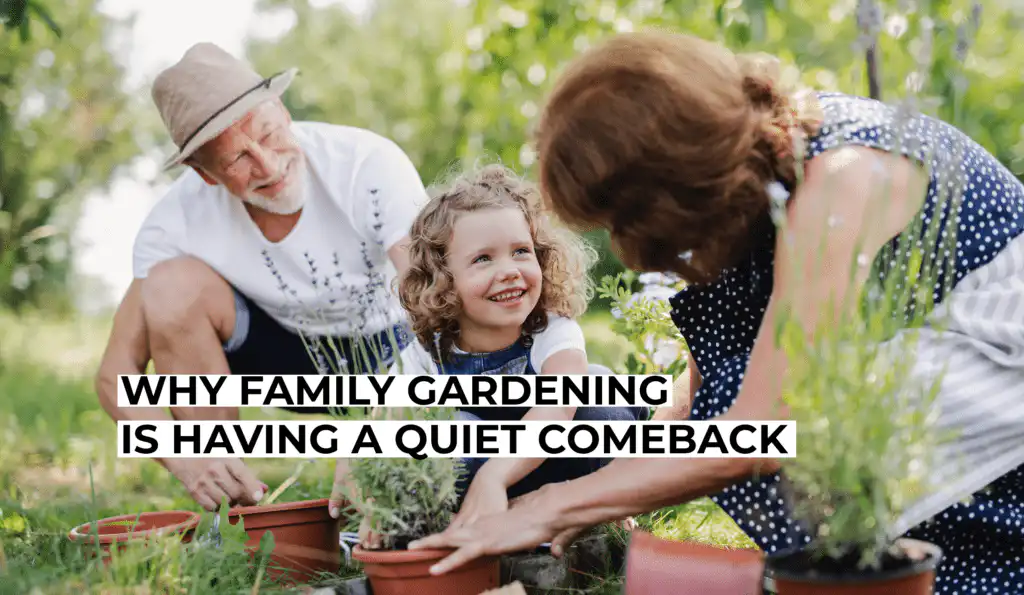
Why Family Gardening Is Having a Quiet Comeback
[et_pb_section fb_built=”1″ _builder_version=”4.16″ _module_preset=”default” global_colors_info=”{}”][et_pb_row _builder_version=”4.16″ _module_preset=”default” custom_margin=”|auto|-13px|auto||” custom_padding=”|||14px||” global_colors_info=”{}”][et_pb_column type=”4_4″ _builder_version=”4.16″ _module_preset=”default” global_colors_info=”{}”][et_pb_text _builder_version=”4.27.5″ _module_preset=”default” custom_padding=”9px|24px|24px|23px||” global_colors_info=”{}”]
Why Family Gardening Is Having a Quiet Comeback
There’s a noticeable shift happening in how families spend their time. It isn’t loud or trend-led, and it’s rarely documented with before-and-after shots. Instead, it’s quieter and slower, rooted in small routines and shared moments. Family gardening is part of that change. More households are rediscovering the value of growing things together, whether that means tending a few pots on a patio or caring for a modest vegetable patch. For many, starting with a handful of vegetable plants has become a way to reconnect with each other and the rhythms of everyday life.
This renewed interest isn’t about producing perfect harvests or becoming self-sufficient overnight. It’s about slowing down, paying attention and finding meaning in ordinary tasks that bring people together.
A response to busy lives
Modern family life is often shaped by full schedules, competing priorities and constant noise. Screens demand attention, routines feel rushed and shared time can become fragmented. Gardening offers something different. It creates space for pauses, for moments where there’s nothing to do except water, weed or notice what’s changed since yesterday.
These tasks don’t require urgency. They can’t be rushed, and that’s part of their appeal. When families garden together, they step into a pace set by nature rather than notifications. Over time, this slower rhythm can feel grounding, especially for children who are growing up in an increasingly fast-moving world.
Learning without lessons
One of the reasons family gardening feels so natural is that learning happens without instruction. Children observe cause and effect simply by being involved. They see what happens when plants are watered regularly, or when they aren’t. They notice how sunlight, weather and time all play a role.
Adults often find themselves learning too. Gardening encourages curiosity and problem-solving, reminding us that not everything has a fixed outcome. Some things thrive, others don’t, and that uncertainty becomes part of the experience rather than a failure.
This shared learning creates a sense of equality. Parents don’t need to have all the answers, and children feel included in the process rather than guided through it.
Sustainability at a human scale
Conversations around sustainability can feel overwhelming, especially when framed in terms of global impact and long-term consequences. Family gardening brings those ideas closer to home, making them tangible and manageable.
Growing food, even in small amounts, highlights the effort and resources involved. It can shift how families think about waste, seasonality and consumption without needing formal discussion. Harvesting something you’ve grown encourages respect for food in a way that buying it rarely does.
This isn’t about achieving perfection or reducing a carbon footprint overnight. It’s about awareness, and about taking part in systems that feel more transparent and connected.
Shared responsibility and routine
Gardening works best when it becomes part of family life rather than an occasional project. Watering plants, checking growth and harvesting when ready are small responsibilities that can be shared across ages.
These routines offer children a sense of contribution. They’re not just helping; they’re needed. For adults, these shared tasks can become moments of connection that don’t require planning or special effort.
Over time, gardening can anchor days and weeks, offering continuity through changing seasons. That sense of return, of doing the same small things regularly, can be reassuring in an otherwise unpredictable world.
[/et_pb_text][et_pb_image src=”https://broodmagazine.com/wp-content/uploads/2026/01/family-with-children-pushed-in-barrow-by-parents-w-2026-01-05-06-29-39-utc-scaled.webp” alt=”Family Gardening” title_text=”Family With Children Pushed In Barrow By Parents Working In Vegetable Garden Or Allotment” _builder_version=”4.27.5″ _module_preset=”default” custom_padding=”||27px|||” global_colors_info=”{}”][/et_pb_image][et_pb_divider _builder_version=”4.27.4″ _module_preset=”default” custom_margin=”-19px||3px|||” global_colors_info=”{}”][/et_pb_divider][et_pb_text _builder_version=”4.27.5″ _module_preset=”default” custom_padding=”9px|24px|7px|23px||” global_colors_info=”{}”]
Sponsored Content:
[/et_pb_text][et_pb_code _builder_version=”4.27.5″ _module_preset=”default” global_colors_info=”{}”]


Redefining productivity
There’s something quietly radical about spending time on an activity that doesn’t demand constant output. Gardening challenges the idea that time must always be optimised or productive in conventional ways.
Progress happens slowly and sometimes invisibly. Seeds take time to grow. Plants rest before producing anything tangible. This process encourages patience and acceptance, values that are often sidelined in daily life.
For families, this can be a gentle counterbalance to performance-driven environments. Gardening becomes a place where effort matters more than results, and where showing up regularly is enough.
Making space for togetherness
One of the most meaningful aspects of family gardening is the way it creates opportunities for conversation. Side by side, hands busy, there’s less pressure to fill silence or direct discussion.
Children may talk about their day, ask unexpected questions or simply narrate what they’re doing. These moments feel unforced because they arise naturally from shared activity rather than structured time together.
For parents, gardening can offer insight into how children see the world. What they notice, what excites them and what frustrates them often becomes clear in these quiet settings.
Accessible, not aspirational
Part of gardening’s renewed appeal lies in its accessibility. It doesn’t require expensive equipment, specialist knowledge or large spaces. A few containers can be enough to get started, making it possible for families in different types of homes to take part.
This simplicity removes pressure. Gardening doesn’t have to look a certain way or meet external expectations. It can be messy, inconsistent and imperfect, and still be worthwhile.
In a culture that often promotes curated lifestyles, family gardening offers something refreshingly ordinary.
A return to the everyday
Perhaps what makes this comeback feel so significant is that it isn’t driven by novelty. Gardening has always been there, quietly waiting. What’s changed is how it fits into modern family life.
As more people look for ways to reconnect with each other and the world around them, gardening provides a familiar but renewed pathway. It brings families back to everyday acts of care, attention and patience.
In tending plants together, families aren’t just growing food. They’re cultivating shared experiences, grounding routines and a slower way of being. And in doing so, they’re rediscovering the value of things that don’t shout for attention, but quietly make life feel more whole.
[/et_pb_text][et_pb_divider _builder_version=”4.27.4″ _module_preset=”default” custom_margin=”||9px|||” custom_padding=”1px||0px|||” global_colors_info=”{}”][/et_pb_divider][et_pb_text _builder_version=”4.27.5″ _module_preset=”default” custom_margin=”-13px|||||” custom_padding=”9px|24px|7px|23px||” global_colors_info=”{}”]
Sponsored Content:
[/et_pb_text][et_pb_code _builder_version=”4.27.5″ _module_preset=”default” global_colors_info=”{}”]


Links
[/et_pb_text][/et_pb_column][et_pb_column type=”1_2″ _builder_version=”4.16″ global_colors_info=”{}”][et_pb_text _builder_version=”4.16″ header_6_font=”Montserrat|700||on|||||” header_6_line_height=”1.8em” custom_margin=”||10px||false|false” locked=”off” global_colors_info=”{}”]
Follow Us
[/et_pb_text][et_pb_social_media_follow icon_color=”#FFFFFF” _builder_version=”4.27.5″ _module_preset=”default” custom_button=”on” button_font=”Montserrat|||on|||||” text_orientation=”center” custom_margin=”4px|-41px|4px|-41px||” custom_padding=”9px|68px|9px|48px||” global_module=”100570″ saved_tabs=”all” global_colors_info=”{}”][et_pb_social_media_follow_network social_network=”instagram” url=”https://www.instagram.com/broodmagazine” _builder_version=”4.20.2″ _module_preset=”default” background_color=”#ea2c59″ global_colors_info=”{}” follow_button=”off” url_new_window=”on”]instagram[/et_pb_social_media_follow_network][et_pb_social_media_follow_network social_network=”facebook” url=”https://www.facebook.com/broodmagazine” _builder_version=”4.16″ _module_preset=”default” background_color=”#3b5998″ global_colors_info=”{}” follow_button=”off” url_new_window=”on”]facebook[/et_pb_social_media_follow_network][et_pb_social_media_follow_network social_network=”linkedin” url=”http://www.linkedin.com/company/brood-magazine” _builder_version=”4.16″ _module_preset=”default” background_color=”#007bb6″ global_colors_info=”{}” follow_button=”off” url_new_window=”on”]linkedin[/et_pb_social_media_follow_network][et_pb_social_media_follow_network social_network=”twitter” url=”https://www.twitter.com/broodmagazine1″ _builder_version=”4.22.2″ _module_preset=”default” background_color=”#000000″ global_colors_info=”{}” follow_button=”off” url_new_window=”on”]twitter[/et_pb_social_media_follow_network][et_pb_social_media_follow_network social_network=”tiktok” url=”https://www.tiktok.com/@broodmagazine” _builder_version=”4.16″ _module_preset=”default” background_color=”#fe2c55″ global_colors_info=”{}” follow_button=”off” url_new_window=”on”]tiktok[/et_pb_social_media_follow_network][et_pb_social_media_follow_network social_network=”youtube” url=”https://www.youtube.com/channel/UCzLh30eP7Tvcys8O6NG3LDA” _builder_version=”4.16″ _module_preset=”default” background_color=”#a82400″ global_colors_info=”{}” follow_button=”off” url_new_window=”on”]youtube[/et_pb_social_media_follow_network][/et_pb_social_media_follow][/et_pb_column][/et_pb_row][/et_pb_section]