

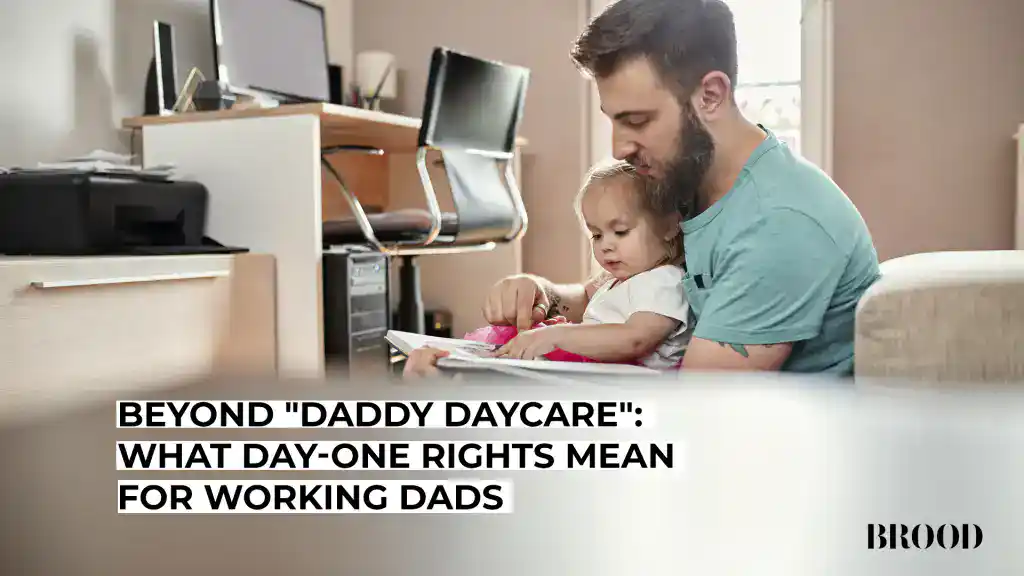
Beyond “Daddy Daycare”: What Day-One Rights Mean for Working Dads
[et_pb_section fb_built=”1″ _builder_version=”4.16″ _module_preset=”default” custom_padding=”||20px|||” global_colors_info=”{}”][et_pb_row _builder_version=”4.16″ _module_preset=”default” custom_padding=”|||14px||” global_colors_info=”{}”][et_pb_column type=”4_4″ _builder_version=”4.16″ _module_preset=”default” global_colors_info=”{}”][et_pb_divider _builder_version=”4.27.4″ _module_preset=”default” global_colors_info=”{}”][/et_pb_divider][et_pb_text _builder_version=”4.27.8″ _module_preset=”default” custom_padding=”9px|24px|7px|23px||” hover_enabled=”0″ global_colors_info=”{}” sticky_enabled=”0″]
Beyond “Daddy Daycare”: What Day-One Rights Mean for Working Dads
For far too long, the UK workplace conversation around flexible working, parental leave, and the domestic “mental load” has leaned overwhelmingly on mothers. Corporate structures have historically operated under an archaic default setting: expecting mothers to step back from their careers to manage household logistics, while assuming fathers should remain unencumbered at their desks. But real, systemic cultural change requires both sides of the same coin.
With the legislative updates under the UK Employment Rights Act, alongside the relentless momentum of grassroots movements like the Parent Strike, Flex Appeal, and The Dad Shift, the country is witnessing an overdue evolution in workplace rights. For working fathers, these legal updates mark a monumental shift—moving away from patronising “daddy daycare” tropes toward genuine, co-parenting equality from day one on the job.
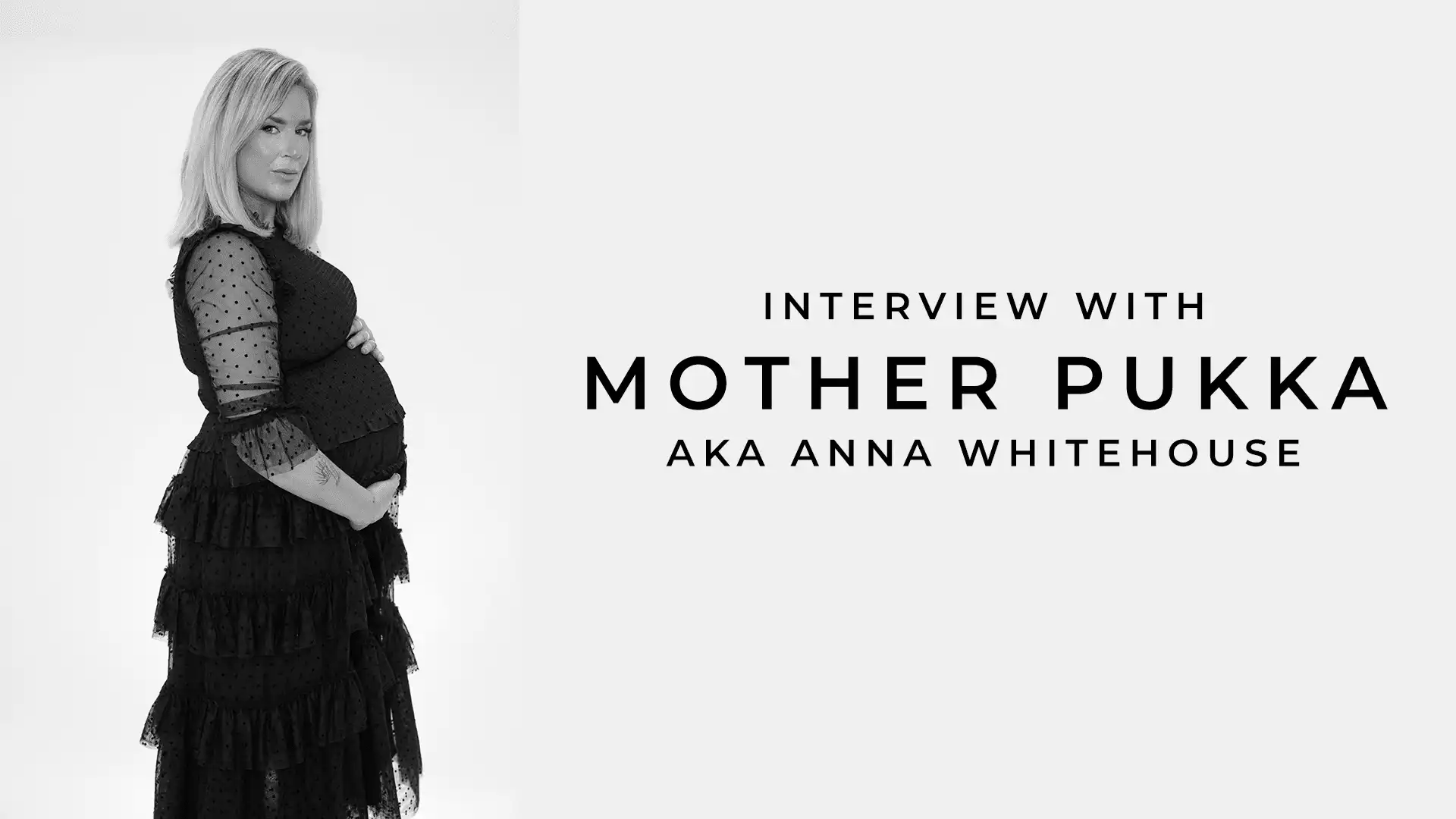
As campaigner and founder Anna Whitehouse (aka Mother Pukka) passionately articulated when she sat down with BROOD Magazine:
“This isn’t just about mums. This is about parents! It’s about dads who are desperately frustrated that their employer won’t enable them to work flexibly because it’s seen as a ‘her-in-doors’ job… Language like ‘daddy daycare’ or ‘babysitting my children’—we’re done with it. You’re parenting.”
— Read the full Mother Pukka interview on BROOD Magazine.
Here is a comprehensive breakdown of what the latest statutory changes mean for fathers, why breaking down the corporate stigma around male caregiving is vital for the entire household, and how you can strategically leverage these changes to protect both your family life and your career trajectory.
1. Day-One Rights: Dismantling the 26-Week Waiting Trap
Answer Summary: Under updated statutory legislation, working fathers and non-birthing partners no longer need to complete 26 weeks or 12 months of continuous service to access paternity leave or submit a formal flexible working request. These entitlements apply from day one of employment, removing the “service trap” that historically prevented parents from changing jobs.
Historically, one of the most toxic mechanisms in the UK job market was the service requirement attached to basic family rights. Under old regulations, if a father wanted to switch jobs to improve his salary, secure a promotion, or escape a toxic environment, he had to calculate a dangerous timeline. Moving companies meant resetting the clock. If his partner became pregnant within the first six months at a new company, he risked losing his statutory paternity rights, along with the right to request flexible working arrangements.

Day-one rights empower working fathers to maintain career momentum without missing key milestones at home.
This dynamic created what career advisors call the “paternal lock-in”—forcing men to remain in stagnant or unfulfilling roles simply to preserve their baseline rights when starting or expanding a family. The new legislation dismantles this barrier entirely through three core mechanisms:
- Immediate Paternity Entitlement: The mandatory 26-week qualification period for statutory paternity leave has been abolished. New employees can access paternity leave and pay frameworks from their very first day on the job.
- Day-One Flexible Working Requests: Dads have the legal standing to submit a formal request for flexible working—including compressed hours, remote or hybrid arrangements, flexible start and finish times, or job-sharing—on day one of their contract.
- Enhanced Employer Accountability: Employers can no longer dismiss flexible working requests with generic, boiler-plate refusals. The legal framework requires management to formally consult with the employee, explore viable alternatives, and provide concrete business grounds if a request cannot be accommodated.
By removing the waiting period, the law encourages greater labour market mobility for parents. Dads no longer have to choose between advancing their professional ambitions and being present during the crucial first months of their child’s life.
2. Challenging the “Her-In-Doors” Stigma & Cultural Friction
Answer Summary: Legislative mandates are vital, but workplace culture often lags behind statutory law. Overcoming the unconscious bias that treats male flexible working as secondary to a mother’s career is essential for establishing true workplace equality and closing the gender pay gap.
Passes in legislation create the foundation, but policy on paper means very little if line managers maintain Victorian attitudes toward modern caregiving. Dads across the UK frequently report an insidious double standard: when a mother asks to leave early for the nursery run, it is often viewed as expected; when a father makes the same request, it is too frequently met with raised eyebrows, jokes about “slacking off,” or subtle career penalties.
During our feature interview with BROOD Magazine, Anna Whitehouse recounted a striking real-world example that illustrates the entrenched bias fathers face daily in corporate environments:
“A dad messaged me and told me that he had put his flexible working request in, and it was rejected on the basis that they said, ‘Can’t your missus do that?’… No! His ‘missus’ might be working elsewhere, or might be a brain surgeon! The assumption that ‘her-in-doors’, ‘ya missus’, the mum, should automatically pick up that childcare slack is so inherently wrong.”
This “her-in-doors” mentality actively harms both parents:
- It Penalises Mothers: When workplace structures default to assuming mothers will handle every school emergency, sickness day, and pickup, women bear 100% of the workplace penalty. It locks mothers out of executive progression, contributing directly to the gender pay gap and female career burnout.
- It Isolates Fathers: Dads who want to be deeply hands-on in their children’s daily lives are made to feel that prioritising family over late-night office presence is a sign of reduced professional ambition or lack of commitment.
- It Feeds the Mental Load: The administrative and emotional overhead of running a household shouldn’t fall on one person. When fathers are granted genuine flexibility, household labour can be split equitably, benefiting the entire family dynamic.
Normalising male flexibility isn’t a favour to fathers; it is a fundamental economic requirement for workplace equality.
[/et_pb_text][et_pb_image src=”https://broodmagazine.com/wp-content/uploads/2026/09/man-comforting-a-child-while-working-on-laptop-2026-03-10-03-19-00-utc.webp” alt=”New Dad paternity leave legislation. Parent holding baby whilst he works” title_text=”A Caring Father Working on Laptop While Holding His Sleeping Chi” _builder_version=”4.27.8″ _module_preset=”default” global_colors_info=”{}”][/et_pb_image][et_pb_divider _builder_version=”4.27.4″ _module_preset=”default” global_colors_info=”{}”][/et_pb_divider][et_pb_text _builder_version=”4.27.5″ _module_preset=”default” global_colors_info=”{}”]SPONSORED CONTENT:[/et_pb_text][et_pb_code _builder_version=”4.27.8″ _module_preset=”default” global_colors_info=”{}”]

3. Paternity Pay Reform: Why 2 Weeks at Statutory Rates Isn’t Enough
Answer Summary: Campaign groups are aggressively lobbying to reform statutory paternity pay. Current statutory rates force up to 1 in 3 new fathers to skip taking statutory leave altogether due to financial strain, making enhanced employer paternity packages a key recruitment differentiator.
While day-one rights represent a massive win, the financial reality of statutory paternity leave remains a major hurdle for UK families. At present, statutory paternity pay sits at a capped weekly rate that covers only a fraction of the average worker’s income. For dual-income households juggling mortgages, rising energy bills, and sky-high nursery fees, taking two weeks at statutory pay is financially unfeasible for many fathers.

Remote working models allow fathers to balance remote project deadlines alongside hands-on caregiving.
Data highlighted by campaigns like The Dad Shift reveals that a staggering number of fathers cut their paternity leave short or take it as standard annual leave simply to avoid a dramatic hit to their household income. This financial pressure creates an immediate dynamic where the mother takes extended maternity leave while the father returns to work within days of the birth, reinforcing traditional roles right at the start of the child’s life.
Progressive employers are quickly recognising that basic statutory compliance is no longer enough to attract and retain top-tier talent. We are seeing a growing divide in the job market:
- Statutory Employers: Companies that meet the bare legal minimum (2 weeks at statutory pay rates). These firms are increasingly losing skilled mid-to-senior professionals to competitors with modern family policies.
- Progressive Employers: Forward-thinking organisations offering 6 to 26 weeks of fully paid parental leave, equalised across mothers and fathers regardless of biological or adoptive status.
When businesses equalise parental leave pay, men take extended time off, mothers return to their careers without bearing the sole burden of care, and employee loyalty and retention skyrocket.
4. Step-by-Step Guide: How Dads Can Submit a Day-One Flex Request
If you are looking to secure a flexible schedule—whether in your current job or as you step into a new role—approaching the negotiation professionally and strategically is critical. Here is a step-by-step framework to maximise your chances of approval:
Step 1: Audit Your Operational Impact
Before submitting a statutory request form, look at your working week through your line manager’s eyes. Identify where your core touchpoints with clients or team members occur and design a model that maintains or enhances productivity.
- For Compressed Hours: Demonstrate how your key deliverables will be met across four intensive days without creating bottlenecks for colleagues.
- For Staggered Hours: Highlight how starting earlier provides quiet, uninterrupted focus time while allowing you to handle afternoon childcare runs.
Step 2: Connect Your Request to Commercial Deliverables
Position your flexible working proposal as a business enabler, not an employee concession. Frame the narrative around sustainable output, clear key performance indicators (KPIs), and long-term focus. Employers respond best to solutions, not problems.
Step 3: Propose a Formal Trial Period
If your employer expresses hesitation or fears opening “floodgates,” offer a trial period (e.g., 3 months). A time-bound trial reduces management anxiety, gives you space to prove the model works, and creates a clear review date to formalise the arrangement.
| Flexibility Model | Ideal For | Key Pitch Point to Employer |
|---|---|---|
| Compressed Hours | Dads wanting a full day dedicated to caregiving without cutting income. | “Delivers 100% of contracted output across four intensive days with zero loss in weekly productivity.” |
| Staggered Start/Finish | Handling nursery or school drop-offs and pickups equitably. | “Provides early-morning uninterrupted focus hours and ensures coverage outside standard office times.” |
| Hybrid / Remote Split | Eliminating long daily commutes to save energy for family time. | “Reduces commute fatigue, increases focus for deep work, and cuts office overhead.” |
5. The Commercial Case: Why Employers Must Adopt the “Carrot” Approach
Answer Summary: Employers who proactively implement modern, dad-friendly flexible policies see higher talent retention, reduced recruitment costs, and stronger productivity compared to companies relying on rigid office mandates.
To conclude our landmark interview with BROOD Magazine, Anna Whitehouse delivered a clear call to action for business owners, founders, and HR leaders across the UK:
“Don’t wait for the laws to change if you’re an employer. Don’t take the stick approach, take the carrot approach. Why aren’t you thinking about how you can retain this brilliant talent? You’re not doing us a favour. We’re great. We’re talented. You’re cutting us out at our prime when we know so much, and then you have to get somebody else in and train them up.”
The financial argument for flexibility is rock solid. Replacing a senior team member who resigns due to burnout or inflexible policies costs businesses tens of thousands of pounds in recruitment fees, onboarding delays, and lost operational momentum. By contrast, building an empathetic, output-focused culture where fathers and mothers can thrive costs very little and yields immense loyalty.
We are moving past the era where long hours at a desk equate to high performance. The future of work belongs to businesses that measure output rather than presenteeism—and to working parents who refuse to apologise for being present in their children’s lives.
Want to read more inspirational stories, industry insights, and career advice for modern parents? Read our full feature interview with Anna Whitehouse (Mother Pukka) right here on BROOD Magazine.
[/et_pb_text][et_pb_divider _builder_version=”4.27.4″ _module_preset=”default” global_colors_info=”{}”][/et_pb_divider][et_pb_text _builder_version=”4.27.5″ _module_preset=”default” global_colors_info=”{}”]SPONSORED CONTENT:[/et_pb_text][et_pb_code _builder_version=”4.27.8″ _module_preset=”default” global_colors_info=”{}”]


Links
[/et_pb_text][/et_pb_column][et_pb_column type=”1_2″ _builder_version=”4.16″ global_colors_info=”{}”][et_pb_text _builder_version=”4.16″ header_6_font=”Montserrat|700||on|||||” header_6_line_height=”1.8em” custom_margin=”||10px||false|false” locked=”off” global_colors_info=”{}”]
Follow Us
[/et_pb_text][et_pb_social_media_follow icon_color=”#FFFFFF” _builder_version=”4.27.5″ _module_preset=”default” custom_button=”on” button_font=”Montserrat|||on|||||” text_orientation=”center” custom_margin=”4px|-41px|4px|-41px||” custom_padding=”9px|68px|9px|48px||” global_module=”100570″ saved_tabs=”all” global_colors_info=”{}”][et_pb_social_media_follow_network social_network=”instagram” url=”https://www.instagram.com/broodmagazine” _builder_version=”4.20.2″ _module_preset=”default” background_color=”#ea2c59″ global_colors_info=”{}” follow_button=”off” url_new_window=”on”]instagram[/et_pb_social_media_follow_network][et_pb_social_media_follow_network social_network=”facebook” url=”https://www.facebook.com/broodmagazine” _builder_version=”4.16″ _module_preset=”default” background_color=”#3b5998″ global_colors_info=”{}” follow_button=”off” url_new_window=”on”]facebook[/et_pb_social_media_follow_network][et_pb_social_media_follow_network social_network=”linkedin” url=”http://www.linkedin.com/company/brood-magazine” _builder_version=”4.16″ _module_preset=”default” background_color=”#007bb6″ global_colors_info=”{}” follow_button=”off” url_new_window=”on”]linkedin[/et_pb_social_media_follow_network][et_pb_social_media_follow_network social_network=”twitter” url=”https://www.twitter.com/broodmagazine1″ _builder_version=”4.22.2″ _module_preset=”default” background_color=”#000000″ global_colors_info=”{}” follow_button=”off” url_new_window=”on”]twitter[/et_pb_social_media_follow_network][et_pb_social_media_follow_network social_network=”tiktok” url=”https://www.tiktok.com/@broodmagazine” _builder_version=”4.16″ _module_preset=”default” background_color=”#fe2c55″ global_colors_info=”{}” follow_button=”off” url_new_window=”on”]tiktok[/et_pb_social_media_follow_network][et_pb_social_media_follow_network social_network=”youtube” url=”https://www.youtube.com/channel/UCzLh30eP7Tvcys8O6NG3LDA” _builder_version=”4.16″ _module_preset=”default” background_color=”#a82400″ global_colors_info=”{}” follow_button=”off” url_new_window=”on”]youtube[/et_pb_social_media_follow_network][/et_pb_social_media_follow][/et_pb_column][/et_pb_row][/et_pb_section]