

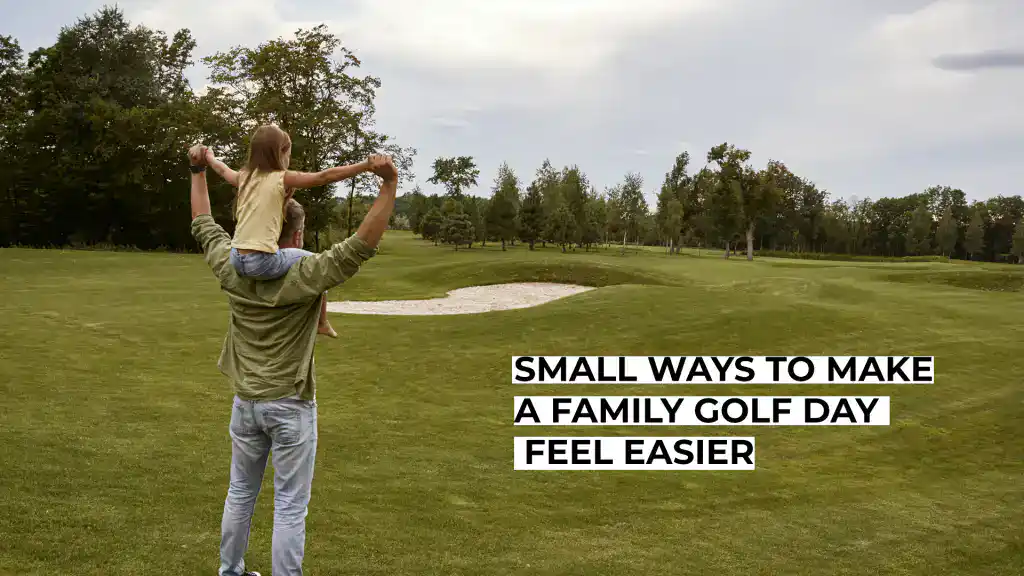
Small Ways to Make a Family Golf Day Feel Easier
[et_pb_section fb_built=”1″ _builder_version=”4.16″ _module_preset=”default” custom_padding=”||20px|||” global_colors_info=”{}”][et_pb_row _builder_version=”4.16″ _module_preset=”default” custom_padding=”|||14px||” global_colors_info=”{}”][et_pb_column type=”4_4″ _builder_version=”4.16″ _module_preset=”default” global_colors_info=”{}”][et_pb_divider _builder_version=”4.27.4″ _module_preset=”default” global_colors_info=”{}”][/et_pb_divider][et_pb_text _builder_version=”4.27.8″ _module_preset=”default” custom_padding=”9px|24px|7px|23px||” hover_enabled=”0″ global_colors_info=”{}” sticky_enabled=”0″]
Small Ways to Make a Family Golf Day Feel Easier
Golf can be a lovely way for families to spend time outdoors together, but it is not always as calm as it looks from the clubhouse window. Add children, changing weather, snacks, forgotten gloves and a busy weekend tee sheet, and a relaxed round can start to feel like a small operation.
The good news is that a family golf day does not need to be complicated. A little planning, a realistic pace and a few thoughtful habits can help everyone enjoy the experience, whether you are playing nine holes, using the practice area or simply introducing a child to the game for the first time.
For parents, the aim is not always to play your lowest score. Often, it is to create a day where everyone feels included, comfortable and keen to come back again.
Start With the Right Version of Golf
A full 18-hole round can be too much for younger children or beginners. Even adults who are returning to the game after a long break may find it tiring. Choosing the right format makes a big difference.
A short course, par-three course or even a family session at the driving range can be a better fit than a traditional round. Nine holes after school or early on a Sunday can feel far more manageable than a long afternoon on the course.
You can also make your own rules. Let children tee off closer to the green. Allow a maximum number of shots on each hole. Skip a hole if energy levels drop. Golf is more enjoyable for families when the format suits the people playing, rather than the other way round.
Pack for Comfort, Not Just Performance
Golf bags can quickly become cluttered, but family golf calls for a few practical extras. Water, sun cream, plasters, a spare layer and easy snacks are often more useful than another training aid.
Children can lose interest quickly if they are cold, hungry or uncomfortable. Adults are not much different. A small snack at the right time can prevent a dip in mood on the fifth hole, especially if the pace of play is slower than expected.
It also helps to think about footwear and clothing before leaving home. Golf courses involve more walking than many children expect. Comfortable shoes, weather-appropriate layers and a cap for sunny days can make the experience feel easier from the start.
Make the Small Rituals Part of the Fun
One of the charming things about golf is that it is full of small rituals. Marking a ball on the green, choosing a club, repairing a pitch mark and writing down a score all help children feel part of the game.
These details are useful teaching moments. They show respect for other players and for the course, but they can also be enjoyable. A child who is allowed to mark a parent’s ball or help tend to a scorecard may feel more involved, even if they are not playing every shot.
For families who enjoy adding small personal touches to their golf days, Aceballmarkers offers custom ball markers that can make this simple part of the game feel a little more personal without adding clutter to a golf bag.
It is often these little details that children remember. Not the final score, but the fact they had a job to do and were trusted to do it.
[/et_pb_text][et_pb_image src=”https://broodmagazine.com/wp-content/uploads/2026/09/children-playing-golf-on-a-sunny-green-field-2026-03-17-20-16-31-utc-scaled.webp” title_text=”Casual kids at a golf field holding golf clubs” _builder_version=”4.27.8″ _module_preset=”default” hover_enabled=”0″ global_colors_info=”{}” sticky_enabled=”0″][/et_pb_image][et_pb_divider _builder_version=”4.27.4″ _module_preset=”default” global_colors_info=”{}”][/et_pb_divider][et_pb_text _builder_version=”4.27.5″ _module_preset=”default” global_colors_info=”{}”]SPONSORED CONTENT:
[/et_pb_text][et_pb_code _builder_version=”4.27.5″ _module_preset=”default” global_colors_info=”{}”]
Keep the Pace Relaxed but Considerate
Family golf is more relaxed when nobody feels rushed, but it is still important to be aware of other groups. This can be a tricky balance for parents, especially when children are learning.
A few simple habits help. Have the next player ready when it is their turn. Move bags and trolleys to the side of the green nearest the next tee. Pick up the ball when a hole is taking too long. These habits keep the round moving without making the day feel strict.
It can also help to explain course etiquette before you arrive. Children are often more cooperative when they know why something matters. Being quiet during another player’s shot or standing in a safe place is not just a rule. It helps everyone enjoy the game.
Create Roles for Non-Players
Not every family member will want to swing a club, and that is fine. Some children are happy to come along if they have a role. They might help spot balls, carry a water bottle, rake a bunker with supervision or keep a fun version of the score.
For younger children, you can turn the walk into a nature trail. Look for birds, trees, ponds or interesting clouds. Golf courses can be surprisingly peaceful places to explore when expectations are sensible.
If someone is not playing, make sure they still feel included. Ask their opinion on which club to use, invite them to roll a few putts on the practice green or let them choose the snack stop. Small choices can make a big difference.
Focus on Encouragement Over Correction
Parents who play golf often want to help, but too much advice can drain the fun from the day. A child does not need a technical breakdown after every swing. They need encouragement, patience and space to enjoy the feeling of hitting the ball.
Try using simple comments. Good balance. Nice rhythm. Great effort. If a child asks for help, offer one small suggestion rather than several. Golf is already a difficult game, and too many instructions can make it feel harder.
It is also worth modelling a healthy attitude. Missed putts, lost balls and poor shots are part of the game. If children see adults laughing off mistakes and moving on, they are more likely to do the same.
Build in Breaks and Natural End Points
A family golf day does not need to end only when the scorecard is complete. Sometimes the right time to stop is when everyone is still happy. That might be after six holes, a bucket of balls or twenty minutes on the putting green.
Building in breaks can help. A pause at the halfway hut, a few minutes on a bench or a relaxed drink afterwards gives the day a rhythm. It also gives children something to look forward to if their attention starts to drift.
Try not to frame stopping early as failure. Leaving while the mood is still positive can make the next visit easier. The aim is to build a connection with the game over time.
Let the Day Be About More Than Golf
Some of the most valuable parts of a family golf day happen between shots. Walking together gives space for conversation. Waiting on a tee can lead to a joke, a question or a quiet moment that might not happen during a busy week at home.
Golf offers rare pockets of unhurried time. Phones can stay in bags. Conversations can wander. Children may open up while walking down a fairway in a way they would not at the dinner table.
That is why expectations matter. If the day is measured only by score, it may feel frustrating. If it is measured by fresh air, shared time and a few memorable shots, it becomes much easier to enjoy.
Conclusion
A family golf day does not have to be polished to be worthwhile. It simply needs a little thought, a flexible plan and a willingness to adapt to the people you are with.
Choose a manageable format, pack for comfort, keep the pace considerate and allow children to feel involved in small ways. Some days will be smooth, and others will include tired legs, lost balls or sudden changes in weather.
That is all part of it. With the right approach, golf can become less about chasing a score and more about creating calm, memorable time together outdoors.
[/et_pb_text][et_pb_divider _builder_version=”4.27.4″ _module_preset=”default” global_colors_info=”{}”][/et_pb_divider][et_pb_text _builder_version=”4.27.5″ _module_preset=”default” global_colors_info=”{}”]SPONSORED CONTENT:
[/et_pb_text][et_pb_code _builder_version=”4.27.7″ _module_preset=”default” global_colors_info=”{}”]

Links
[/et_pb_text][/et_pb_column][et_pb_column type=”1_2″ _builder_version=”4.16″ global_colors_info=”{}”][et_pb_text _builder_version=”4.16″ header_6_font=”Montserrat|700||on|||||” header_6_line_height=”1.8em” custom_margin=”||10px||false|false” locked=”off” global_colors_info=”{}”]
Follow Us
[/et_pb_text][et_pb_social_media_follow icon_color=”#FFFFFF” _builder_version=”4.27.5″ _module_preset=”default” custom_button=”on” button_font=”Montserrat|||on|||||” text_orientation=”center” custom_margin=”4px|-41px|4px|-41px||” custom_padding=”9px|68px|9px|48px||” global_module=”100570″ saved_tabs=”all” global_colors_info=”{}”][et_pb_social_media_follow_network social_network=”instagram” url=”https://www.instagram.com/broodmagazine” _builder_version=”4.20.2″ _module_preset=”default” background_color=”#ea2c59″ global_colors_info=”{}” follow_button=”off” url_new_window=”on”]instagram[/et_pb_social_media_follow_network][et_pb_social_media_follow_network social_network=”facebook” url=”https://www.facebook.com/broodmagazine” _builder_version=”4.16″ _module_preset=”default” background_color=”#3b5998″ global_colors_info=”{}” follow_button=”off” url_new_window=”on”]facebook[/et_pb_social_media_follow_network][et_pb_social_media_follow_network social_network=”linkedin” url=”http://www.linkedin.com/company/brood-magazine” _builder_version=”4.16″ _module_preset=”default” background_color=”#007bb6″ global_colors_info=”{}” follow_button=”off” url_new_window=”on”]linkedin[/et_pb_social_media_follow_network][et_pb_social_media_follow_network social_network=”twitter” url=”https://www.twitter.com/broodmagazine1″ _builder_version=”4.22.2″ _module_preset=”default” background_color=”#000000″ global_colors_info=”{}” follow_button=”off” url_new_window=”on”]twitter[/et_pb_social_media_follow_network][et_pb_social_media_follow_network social_network=”tiktok” url=”https://www.tiktok.com/@broodmagazine” _builder_version=”4.16″ _module_preset=”default” background_color=”#fe2c55″ global_colors_info=”{}” follow_button=”off” url_new_window=”on”]tiktok[/et_pb_social_media_follow_network][et_pb_social_media_follow_network social_network=”youtube” url=”https://www.youtube.com/channel/UCzLh30eP7Tvcys8O6NG3LDA” _builder_version=”4.16″ _module_preset=”default” background_color=”#a82400″ global_colors_info=”{}” follow_button=”off” url_new_window=”on”]youtube[/et_pb_social_media_follow_network][/et_pb_social_media_follow][/et_pb_column][/et_pb_row][/et_pb_section]