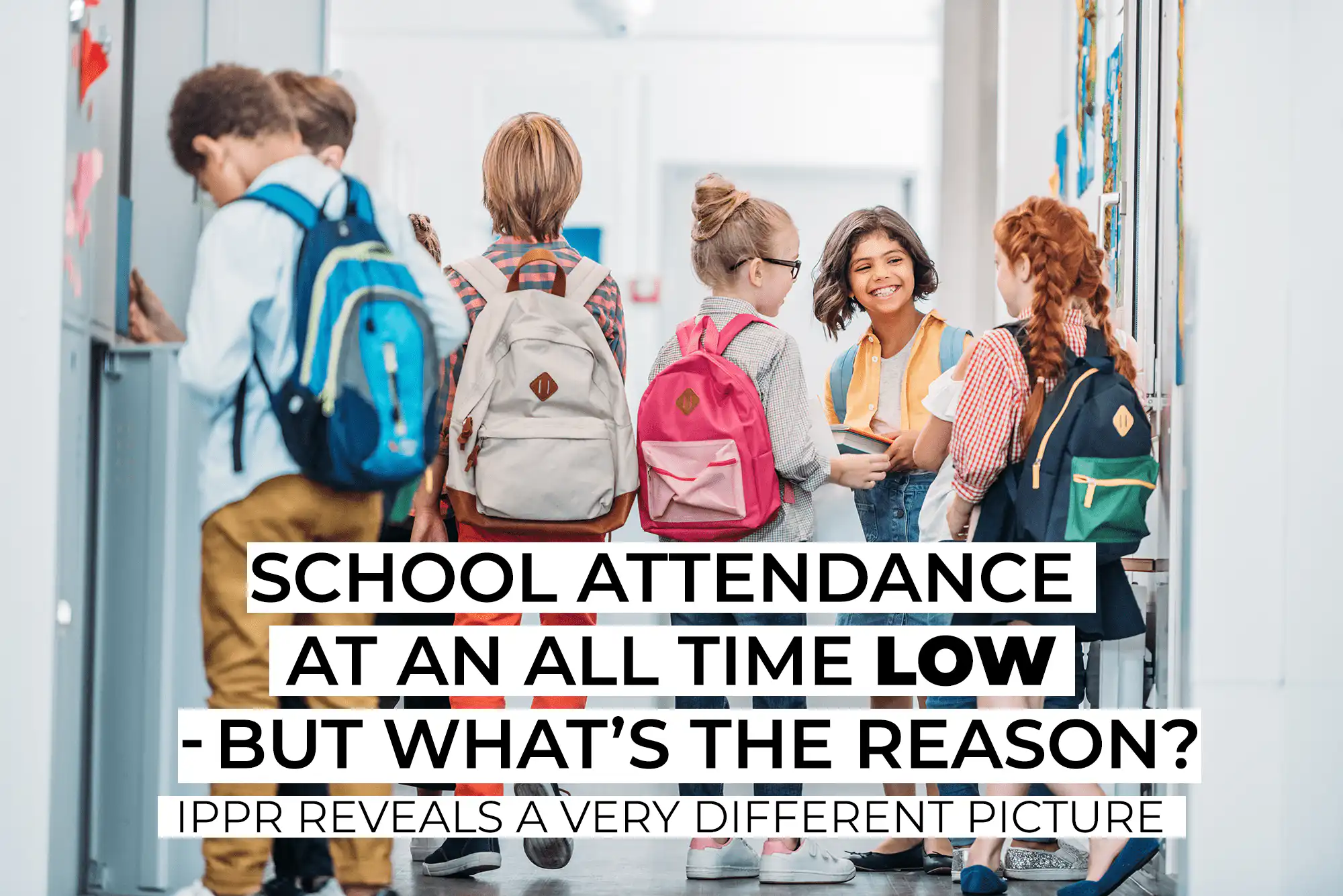
When you look at the current focus on fining parents who take their children out of school for holidays, you’d think that was the main reason why there is an issue with school attendance levels. However, the latest report from the Institute of for Public Policy Research (IPPR) reveals a very different picture.
School attendance is at a crisis level, but the key issue is not a cheaper couple of days at Center Parcs, but the very serious issue educational settings not being able to meet children’s needs be that for children with SEN needs, or the who are experiencing bullying and experiencing anxiety, especially post-Covid and the experience of lockdowns on children and young people.
This important report from the IPPR and The Difference today sets out a plan to end the rapid rise in absence, exclusions and the special educational needs crisis that all drive lost learning. Five years on from schools going into lockdown, the report has brought together more than 100 teachers, leaders, students, parent groups and charities to pinpoint the root causes of lost learning, and to find solutions.
Reading the report it couldn’t have been more fitting as yesterday, just like many parents throughout the UK, Lolo couldn’t take her 5 year old autistic son to school because he was distressed and over stimulated, and it wouldn’t have been fair on them, him or us to take him into school knowing that they didn’t have the facilities or staff to help him. Last week he was in school for less than hour before we had to collect him again. Some weeks he copes really well, and others are a real struggle and this is a child who has had an autism diagnosis at 4, ECHP since October term of starting in Reception, funding for a 1:1 and who goes to an outstanding primary school. A specialist school is listed on his EHCP, but who knows how long it will before he is actually moved to that setting.

Lolo’s son is non-speaking at present, and as a parent it is heartbreaking to know how crucial early intervention is for children with SEN needs, but to not have any access to such facilities. I dread to think of what the families who have children waiting years for diagnosis and ECHPs feel and experience. With two older children aged 12 and 13, one of whom also has SEN needs, I’ve seen first-hand the rapid decline in support in schools and the lack of funding and support from the local authority; you can feel the frustration from the teachers too.
Maybe instead of the local authorities concentrating so much of their admin time into fining parents – who most of the time are hard working parents who just want to give their children life-enhancing experiences, spend quality family time together and simply require more flexibility as to when the can take them on holiday as more and more families have both sets of parents working, and – and let’s focus the extra time and energy into solving the real problems as to why our children are not in school. It’s always one of the first topics of conversation when I meet another other SEN parent.
Also, look at the very real issue of bullying and subsequent anxiety for young people, who are experiencing intimidating behaviour in the classroom that they cannot escape from, as it follows them online and across social media platforms into the evenings and weekends. Even if we take their phones away, they can feel anxiety thinking about what is being posted and said about them when they are offline.
We cannot accept the narrative that a skiing trip is a beneficial cultural and social experience when put on by a school, but irresponsible when part of a family trip. We need to acknowledge how much more expensive holidays are in school holidays, and how much the cost of living has risen for everyone – it is harder than ever raising a family.
If we care about our children’s education, we can support parents to ensure there is consistent learning during term-times including remote learning where needed, and build trusted relationships between families and schools. By blaming parents for absenteeism when the actual issue is that many children’s needs are not being met and there are many children that have dropped out of the education system post-Covid, this approach is not going to improve attendance levels in a meaningful way.
Children and young people need schools to be safe places, where they can have an enjoyable education and they are not fearful of going to school. Let’s focus on this and deal with actual problems we have, rather than blaming parents who are trying to give their children a balanced, happy life, that can include the occasional affordable holiday with their family.



Escape the Chaos & The Family Lunch: Food Review
Escape the chaos of the summer holidays and moving boxes with a true taste of Italy. Join us for a family-friendly review of San Carlo Alderley Edge, featuring their fantastic new kids’ menu, authentic Italian dishes, and a stress-free dining experience for parents and children alike.

Beyond “Daddy Daycare”: What Day-One Rights Mean for Working Dads
From day-one flexible working requests to dismantling outdated “daddy daycare” tropes, the UK workplace landscape is shifting. Discover what the new legislation means for working fathers, co-parenting equality, and your career.

Ryan Libbey on the True Meaning of Strength, Parenting & Modern Masculinity
Fatherhood and a traumatic first year reshaped Ryan Libbey’s understanding of true strength, partnership, and modern masculinity. From navigating primary caregiving and supporting his partner Louise through medical trauma to writing “Letters to Leo” and challenging the noisy toxicity of the “Manosphere,” Ryan shares his honest, vulnerable journey on what it really means to show up as a present dad.
Back to School 2026: The Ultimate Kids’ Essentials & Parent Hacks
Back to School Special Back to School 2026: The Ultimate Kids’ Essentials & Parent Hacks From seamless uniform upgrades to smart tech that keeps kids focused and safe, here is our editorial edit for the new school term. Between sorting uniforms, replacing outgrown...
Why Learning a Language as a Busy Parent Is One of the Best Things You Can Do (And How to Actually Make It Happen)
Travel Why Learning a Language as a Busy Parent Is One of the Best Things You Can Do (And How to Actually Make It Happen) No classroom. No fixed timetable. Just you, a real tutor, and a skill that'll stick around for life. When was the last time you did something...

Ibiza Comes to London: Why the Alto x Cotton Beach Club Collab Belongs on Every Parent’s Night-Off List
Ibiza isn’t on the cards for most of us this summer — but that doesn’t mean you can’t get a taste of it. Alto by San Carlo has partnered with the iconic Cotton Beach Club Ibiza for two exclusive evenings on the rooftop of Selfridges, London. Think sun-soaked Mediterranean food, live DJ sets, Champagne and London’s skyline as your backdrop. Two dates only — and honestly? You deserve this one.

Lisa Johnson: From £30K Debt to Multi-Millionaire – How a Mum of Two Built a Freedom-Focused Business
Discover how Lisa Johnson, award-winning entrepreneur and mum of twins, went from £30,000 in debt to building a multi-million-pound business in just seven years. In this exclusive interview, Lisa shares her journey through adversity, her strategies for scaling with passive income, and her honest advice for parents and entrepreneurs seeking financial freedom, work-life balance, and lasting impact. Keywords: Lisa Johnson, entrepreneur, passive income, business strategy, work-life balance, financial freedom, mumpreneur, online business, success story.
School Holiday Jigsaw: Surviving the Summer Holidays as a Working Parent
School Holiday Jigsaw: Surviving the Summer Holidays as a Working Parent
For school children, the six-week break is a magical expanse of unstructured freedom. For working parents, it marks the beginning of a military-grade logistical operation. Between the skyrocketing costs of summer camps, tag-teaming annual leave with partners, and attempting the ultimate high-wire act of working from home with a laptop on your knee, the math of July and August simply doesn’t add up. We dive deep into the reality of trying to fit a 19th-century agricultural school calendar into a 21st-century digital economy—and explore the progressive workplace shifts needed to save our sanity.

The Cognitive Crutch: Are We Outsourcing Our kid’s Brains to AI?
The Cognitive Crutch: Are We Outsourcing Our Children’s Brains to AI?
Generative AI has transitioned from a novel tech trend to a permanent classroom fixture. But as tools like ChatGPT effortlessly handle the heavy cognitive lifting of writing essays and solving equations, educators and neuroscientists are raising an urgent alarm. True learning is rooted in the cognitive friction of arriving at an answer. By outsourcing that struggle to machines, are we causing intellectual stamina to atrophy, leaving behind a generation of brilliant curators who have lost the ability to think independently? From primary schools to university campuses, the data reveals a stark shift from active learning to passive “cognitive offloading.”

The Big 2026 British Playcation: The Ultimate Free, Low-Cost & Premium Summer Days Out
The six-week school summer holidays are here, but keeping kids entertained shouldn’t break the bank. With new data showing a massive “play gap” across the UK, we’ve rounded up 11 of the absolute best national initiatives, free community festivals, heavily discounted active-play passes, and premium family adventures to help you balance the budget while creating unforgettable summer memories.