

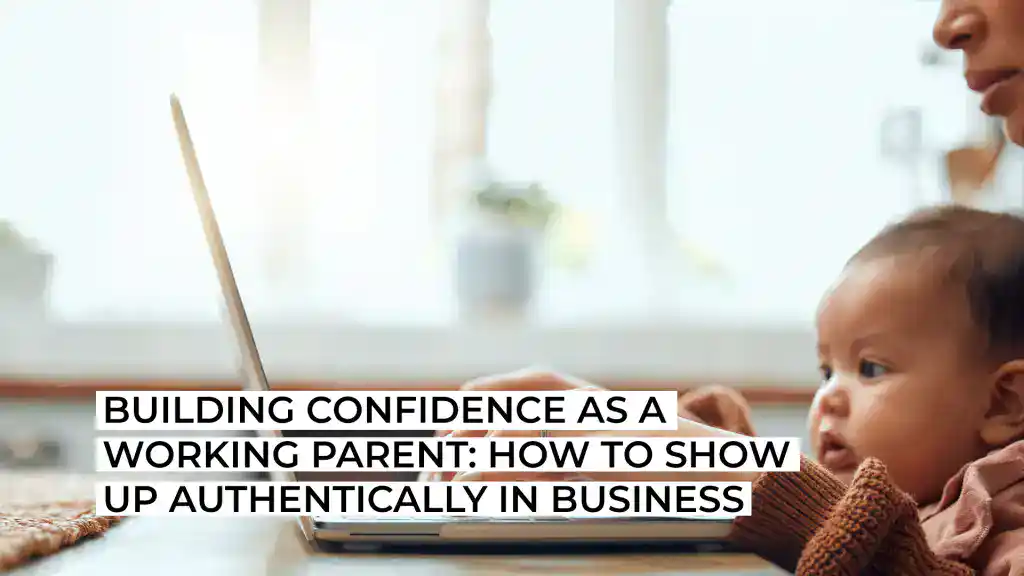
Building confidence as a working parent: how to show up authentically in business
[et_pb_section fb_built=”1″ _builder_version=”4.16″ _module_preset=”default” custom_padding=”||20px|||” global_colors_info=”{}”][et_pb_row _builder_version=”4.16″ _module_preset=”default” custom_padding=”|||14px||” global_colors_info=”{}”][et_pb_column type=”4_4″ _builder_version=”4.16″ _module_preset=”default” global_colors_info=”{}”][et_pb_text _builder_version=”4.27.5″ _module_preset=”default” custom_padding=”9px|24px|24px|23px||” hover_enabled=”0″ global_colors_info=”{}” sticky_enabled=”0″]
Building confidence as a working parent: how to show up authentically in business
Having a child causes a seismic shift in your life. From nappies and bottles to children’s TV, your world tilts to accommodate your little one, and it’s not uncommon for a new personal identity to emerge as it does. You’re a parent now, first and foremost.
But what happens when you need to return to work? If shifting back into a professional persona feels daunting, you’re not alone, with 90% of parents experiencing anxiety when heading back to their 9-5. The good news, though, is that you don’t have to let fear stop you.
In this guide, we’ll explore tried and tested tips to build your confidence as a working parent and show up authentically both at home and in the workplace.
Reflect on Your Professional Identity
It’s normal to feel out of touch with the professional world when you’ve been focused on parenting. Spreadsheets and meetings haven’t exactly been at the forefront of your mind, after all.
To build your confidence, start slowly transitioning back into your professional persona. Begin with a bit of journalling about your professional life, using prompts like:
- Why is my career important to me?
- What do I most love about my work?
- What values affect the way I work and interact with colleagues?
- What’s been the proudest moment of my career so far?
As you write, you’ll start to shift your headspace back into the working world. You’ll rediscover your professional identity and open the door to life beyond parenthood, which is vital if you want to head back to the office with confidence.
Create a List of Career Wins
Sometimes, you just need to remind yourself that you’ve got this. A ‘career wins’ list does just that, helping you remember all the successful points of your working life.
List every win you can think of, no matter how small it may seem. You might have helped a colleague learn a new system, navigated a tricky conversation with a client, or delivered a project to a deadline, for example.
Spend around 30-40 minutes on your list, digging deep into all the times you showed up for work in the right way.This focus on real wins shifts your self-perception. It removes negative, unrealistic ideas of what you’re like at work, and roots your viewpoint in real, positive examples of why you should be confident as a working parent.
[/et_pb_text][et_pb_image src=”https://broodmagazine.com/wp-content/uploads/2026/05/mother-and-child-working-from-home-2026-01-06-09-36-26-utc-scaled.webp” title_text=”Young mother with capricious little son” _builder_version=”4.27.5″ _module_preset=”default” global_colors_info=”{}”][/et_pb_image][et_pb_divider _builder_version=”4.27.4″ _module_preset=”default” global_colors_info=”{}”][/et_pb_divider][et_pb_text _builder_version=”4.27.5″ _module_preset=”default” global_colors_info=”{}”]SPONSORED CONTENT:
[/et_pb_text][et_pb_code _builder_version=”4.27.4″ _module_preset=”default” global_colors_info=”{}”]

Make Sure You Look the Part
Feeling confident in your appearance drastically boosts self-esteem. 72% of people agree that clear skin makes them feel more confident, for instance, while 73% agree that good clothing has a positive impact on self-perception.
When you’re heading back to work as a parent, take a little time to create your professional appearance. This is also an excellent opportunity to practice a bit of self-care, something that working parents often put on the back burner.
Start with your wardrobe. Build up a ‘power-house uniform’ that instantly makes you feel more confident while staying true to your style. Focus on staple items that you love to wear, and reserve these looks solely for work days.
Creating a polished professional appearance also comes down to the smaller self-care details that help you feel put together. From skincare routines to investing in quality manicure and pedicure equipment, these simple habits can boost confidence and help working parents feel more prepared for the workplace.
If you’ve let your aesthetic and health appointments slide as a new parent, now’s the time to get back on track. Book a teeth whitening treatment at The Dental Practice, a PT session at The Gym Group or a class at PureGym, and a haircut at your local salon. Whatever you need to feel your best before heading back to work.
Assert Yourself at Work
Being a parent teaches you skills that often translate into the workplace. While you’re not likely to be changing nappies or spoon-feeding puree, you will need to assert yourself, and you can use what you learn from raising your children to help you.
Little ones push boundaries. Part of being a parent is speaking out for yourself and, when you need to, saying no. It gives you a confident voice, and you can definitely bring aspects of that persona into the workplace.
Whether you’re navigating pay rises or advocating for your ideas in meetings, use that same calm, certain tone to speak your mind. This isn’t about creating conflict, but about knowing when and how to share your opinions and set boundaries.
Keep Showing Up
Confidence isn’t a lack of fear; it’s feeling the fear and doing it anyway. Remember that you’re not in the minority, here, and what you’re feeling isn’t just normal, but conquerable.
Showing up to work even when you’re not feeling confident teaches your brain that you’re capable. It shows you how to navigate challenging situations, too, which reduces the anxiety around them.
When you’ve doubted yourself, done it anyway, and succeeded, you’ll realise that there’s not much out there that can stop you.
Final Thoughts
Building confidence as a working parent doesn’t happen overnight. But, as you keep getting up, dressing up, and showing up, those annoying self-doubts will grow quieter, and the voice that says I’ve got this will become louder. Be kind to yourself and remember that, just like parenthood, this is a journey.
Looking for more support as a working parent? Check out the latest in BROOD Magazine.
[/et_pb_text][et_pb_divider _builder_version=”4.27.4″ _module_preset=”default” global_colors_info=”{}”][/et_pb_divider][et_pb_text _builder_version=”4.27.5″ _module_preset=”default” global_colors_info=”{}”]SPONSORED CONTENT:
[/et_pb_text][et_pb_code _builder_version=”4.27.5″ _module_preset=”default” global_colors_info=”{}”]

Links
[/et_pb_text][/et_pb_column][et_pb_column type=”1_2″ _builder_version=”4.16″ global_colors_info=”{}”][et_pb_text _builder_version=”4.16″ header_6_font=”Montserrat|700||on|||||” header_6_line_height=”1.8em” custom_margin=”||10px||false|false” locked=”off” global_colors_info=”{}”]
Follow Us
[/et_pb_text][et_pb_social_media_follow icon_color=”#FFFFFF” _builder_version=”4.27.5″ _module_preset=”default” custom_button=”on” button_font=”Montserrat|||on|||||” text_orientation=”center” custom_margin=”4px|-41px|4px|-41px||” custom_padding=”9px|68px|9px|48px||” global_module=”100570″ saved_tabs=”all” global_colors_info=”{}”][et_pb_social_media_follow_network social_network=”instagram” url=”https://www.instagram.com/broodmagazine” _builder_version=”4.20.2″ _module_preset=”default” background_color=”#ea2c59″ global_colors_info=”{}” follow_button=”off” url_new_window=”on”]instagram[/et_pb_social_media_follow_network][et_pb_social_media_follow_network social_network=”facebook” url=”https://www.facebook.com/broodmagazine” _builder_version=”4.16″ _module_preset=”default” background_color=”#3b5998″ global_colors_info=”{}” follow_button=”off” url_new_window=”on”]facebook[/et_pb_social_media_follow_network][et_pb_social_media_follow_network social_network=”linkedin” url=”http://www.linkedin.com/company/brood-magazine” _builder_version=”4.16″ _module_preset=”default” background_color=”#007bb6″ global_colors_info=”{}” follow_button=”off” url_new_window=”on”]linkedin[/et_pb_social_media_follow_network][et_pb_social_media_follow_network social_network=”twitter” url=”https://www.twitter.com/broodmagazine1″ _builder_version=”4.22.2″ _module_preset=”default” background_color=”#000000″ global_colors_info=”{}” follow_button=”off” url_new_window=”on”]twitter[/et_pb_social_media_follow_network][et_pb_social_media_follow_network social_network=”tiktok” url=”https://www.tiktok.com/@broodmagazine” _builder_version=”4.16″ _module_preset=”default” background_color=”#fe2c55″ global_colors_info=”{}” follow_button=”off” url_new_window=”on”]tiktok[/et_pb_social_media_follow_network][et_pb_social_media_follow_network social_network=”youtube” url=”https://www.youtube.com/channel/UCzLh30eP7Tvcys8O6NG3LDA” _builder_version=”4.16″ _module_preset=”default” background_color=”#a82400″ global_colors_info=”{}” follow_button=”off” url_new_window=”on”]youtube[/et_pb_social_media_follow_network][/et_pb_social_media_follow][/et_pb_column][/et_pb_row][/et_pb_section]