

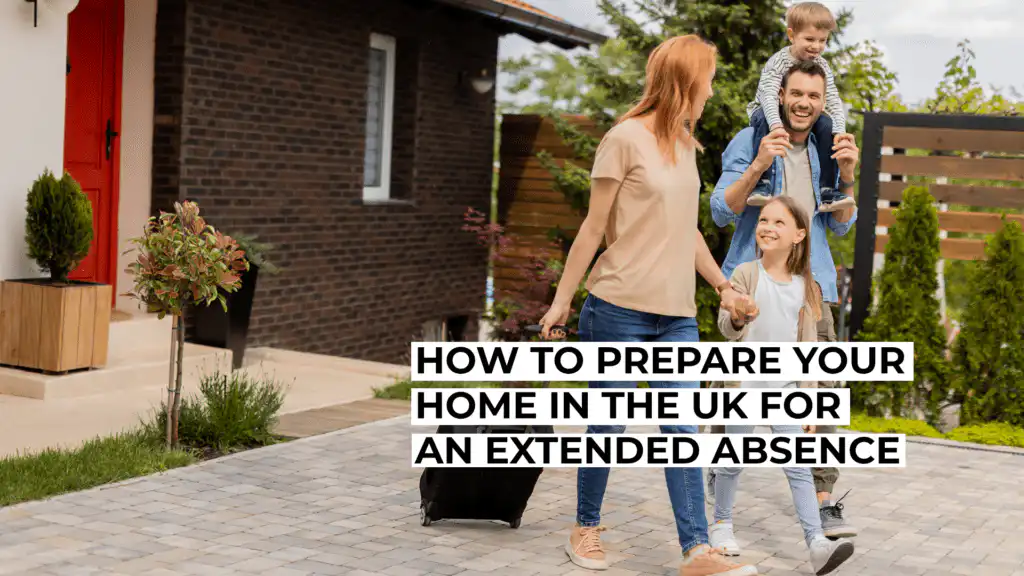
How to Prepare Your Home in the UK for an Extended Absence
[et_pb_section fb_built=”1″ _builder_version=”4.16″ _module_preset=”default” global_colors_info=”{}”][et_pb_row _builder_version=”4.16″ _module_preset=”default” custom_padding=”|||14px||” global_colors_info=”{}”][et_pb_column type=”4_4″ _builder_version=”4.16″ _module_preset=”default” global_colors_info=”{}”][et_pb_text _builder_version=”4.27.5″ _module_preset=”default” custom_padding=”9px|24px|24px|23px||” hover_enabled=”0″ global_colors_info=”{}” sticky_enabled=”0″]
How to Prepare Your Home in the UK for an Extended Absence
Leaving your home empty for an extended period, whether for work abroad, long-term travel, or medical care, requires thorough preparation. An unattended property faces increased risks from burst pipes to break-ins, and standard home insurance policies typically restrict cover once a property has been vacant for 30 to 60 days. Taking the right precautions protects your investment and ensures you’re not left exposed if something goes wrong while you’re away.
Many homeowners don’t realise that their regular insurance may become invalid after just a month of vacancy. Follow along to learn what needs to be done before you leave, so you don’t suffer any costly surprises later on.
Securing Your Property Against Break-Ins
An empty home becomes a target for opportunistic thieves. Make your property look occupied by using automatic timers for lights and keeping curtains partially open. Physical security is crucial: check all locks function properly, consider upgrading to British Standard locks, and ensure your burglar alarm is active.
Cancel newspaper and milk deliveries, as piled-up post can signal an empty property. Arrange for a trusted neighbour to collect your post regularly and park in your driveway occasionally. Never advertise your absence on social media while you’re away.
Unoccupied Property Insurance
Once your property will be empty for more than your standard policy allows (typically 30 to 60 days), you’ll need specialist unoccupied property insurance. This type of cover is specifically designed for vacant properties and accounts for the increased risks associated with homes that aren’t regularly occupied.
Standard home insurance won’t protect you once the property exceeds the vacancy period specified in your policy terms. Even if you’ve been paying premiums, any claim made during an unauthorised vacancy period will likely be rejected.
Specialist unoccupied cover comes in different levels. Basic policies cover fundamental risks like fire, lightning, and explosion, while comprehensive options include theft, malicious damage, and escape of water. Just keep in mind that you’ll need to meet certain conditions, such as maintaining adequate security and, during winter months, keeping heating on or draining the water system.
[/et_pb_text][et_pb_image src=”https://broodmagazine.com/wp-content/uploads/2026/02/private-property-sign-on-gate-door-in-london-keep-2026-01-11-08-03-16-utc-scaled.webp” alt=”Cruises” title_text=”private-property-sign-on-gate-door-in-london-keep-2026-01-11-08-03-16-utc” _builder_version=”4.27.5″ _module_preset=”default” custom_padding=”||26px|||” hover_enabled=”0″ global_colors_info=”{}” sticky_enabled=”0″][/et_pb_image][et_pb_divider _builder_version=”4.27.4″ _module_preset=”default” custom_margin=”-19px||3px|||” global_colors_info=”{}”][/et_pb_divider][et_pb_code _builder_version=”4.27.5″ _module_preset=”default” hover_enabled=”0″ global_colors_info=”{}” sticky_enabled=”0″]
[/et_pb_text][/et_pb_column][/et_pb_row][/et_pb_section][et_pb_section fb_built=”1″ admin_label=”Related Articles” _builder_version=”4.16″ global_colors_info=”{}”][et_pb_row _builder_version=”4.27.4″ _module_preset=”default” global_colors_info=”{}”][et_pb_column type=”4_4″ _builder_version=”4.27.4″ _module_preset=”default” global_colors_info=”{}”][et_pb_divider _builder_version=”4.27.4″ _module_preset=”default” global_colors_info=”{}”][/et_pb_divider][et_pb_code _builder_version=”4.27.5″ _module_preset=”default” hover_enabled=”0″ global_colors_info=”{}” sticky_enabled=”0″]


Links
[/et_pb_text][/et_pb_column][et_pb_column type=”1_2″ _builder_version=”4.16″ global_colors_info=”{}”][et_pb_text _builder_version=”4.16″ header_6_font=”Montserrat|700||on|||||” header_6_line_height=”1.8em” custom_margin=”||10px||false|false” locked=”off” global_colors_info=”{}”]
Follow Us
[/et_pb_text][et_pb_social_media_follow icon_color=”#FFFFFF” _builder_version=”4.27.5″ _module_preset=”default” custom_button=”on” button_font=”Montserrat|||on|||||” text_orientation=”center” custom_margin=”4px|-41px|4px|-41px||” custom_padding=”9px|68px|9px|48px||” global_module=”100570″ saved_tabs=”all” global_colors_info=”{}”][et_pb_social_media_follow_network social_network=”instagram” url=”https://www.instagram.com/broodmagazine” _builder_version=”4.20.2″ _module_preset=”default” background_color=”#ea2c59″ global_colors_info=”{}” follow_button=”off” url_new_window=”on”]instagram[/et_pb_social_media_follow_network][et_pb_social_media_follow_network social_network=”facebook” url=”https://www.facebook.com/broodmagazine” _builder_version=”4.16″ _module_preset=”default” background_color=”#3b5998″ global_colors_info=”{}” follow_button=”off” url_new_window=”on”]facebook[/et_pb_social_media_follow_network][et_pb_social_media_follow_network social_network=”linkedin” url=”http://www.linkedin.com/company/brood-magazine” _builder_version=”4.16″ _module_preset=”default” background_color=”#007bb6″ global_colors_info=”{}” follow_button=”off” url_new_window=”on”]linkedin[/et_pb_social_media_follow_network][et_pb_social_media_follow_network social_network=”twitter” url=”https://www.twitter.com/broodmagazine1″ _builder_version=”4.22.2″ _module_preset=”default” background_color=”#000000″ global_colors_info=”{}” follow_button=”off” url_new_window=”on”]twitter[/et_pb_social_media_follow_network][et_pb_social_media_follow_network social_network=”tiktok” url=”https://www.tiktok.com/@broodmagazine” _builder_version=”4.16″ _module_preset=”default” background_color=”#fe2c55″ global_colors_info=”{}” follow_button=”off” url_new_window=”on”]tiktok[/et_pb_social_media_follow_network][et_pb_social_media_follow_network social_network=”youtube” url=”https://www.youtube.com/channel/UCzLh30eP7Tvcys8O6NG3LDA” _builder_version=”4.16″ _module_preset=”default” background_color=”#a82400″ global_colors_info=”{}” follow_button=”off” url_new_window=”on”]youtube[/et_pb_social_media_follow_network][/et_pb_social_media_follow][/et_pb_column][/et_pb_row][/et_pb_section]