

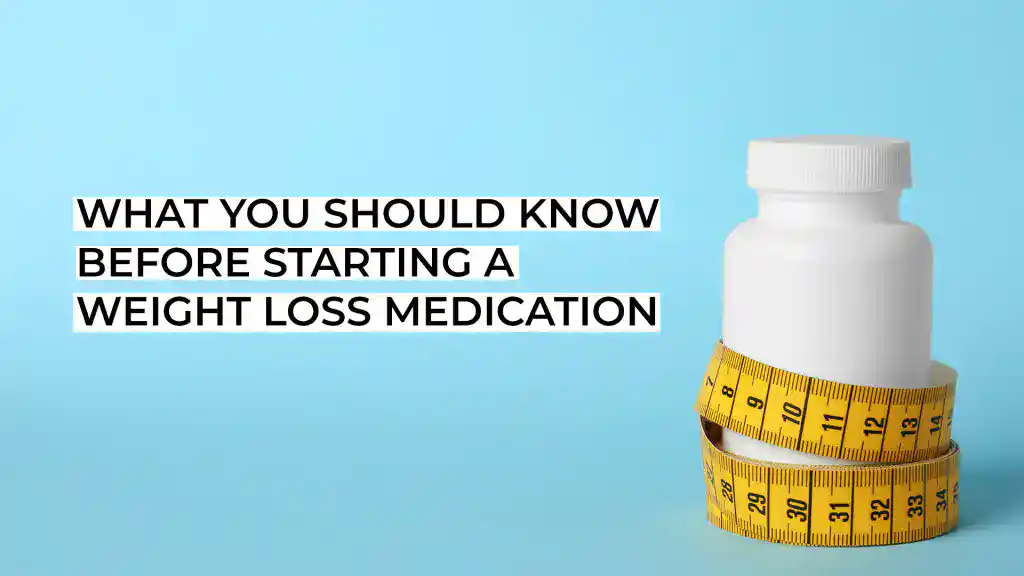
What You Should Know Before Starting a Weight Loss Medication
[et_pb_section fb_built=”1″ _builder_version=”4.16″ _module_preset=”default” custom_padding=”||8px|||” global_colors_info=”{}”][et_pb_row _builder_version=”4.16″ _module_preset=”default” custom_padding=”|||14px||” global_colors_info=”{}”][et_pb_column type=”4_4″ _builder_version=”4.16″ _module_preset=”default” global_colors_info=”{}”][et_pb_text _builder_version=”4.27.5″ _module_preset=”default” custom_padding=”9px|24px|24px|23px||” hover_enabled=”0″ global_colors_info=”{}” sticky_enabled=”0″]
What You Should Know Before Starting a Weight Loss Medication
Weight loss medication is everywhere right now. Scroll through social media, listen to a podcast, or chat with friends, and chances are the topic will come up. But while these treatments have opened new doors for many people, they also come with plenty of misconceptions.
Medication alone won’t completely change your lifestyle overnight. Before you start any treatment, it helps to understand how weight loss medication works, what changes you may need to make, and why medical support matters from day one.
Know What You’re Signing Up For
Starting a weight loss medication isn’t the same as starting a short-term diet. Most prescription treatments work by helping control appetite, slowing digestion, or reducing cravings. That support can make healthier habits easier to maintain, but it doesn’t remove the need for those habits altogether.
Before committing to treatment, spend time carefully researching your options. Different medications suit different people depending on factors such as medical history, lifestyle, and weight-management goals. Some treatments involve daily tablets, while others involve weekly injections under medical supervision.
If you’re considering injectable options, Wegovy injection is one example — a treatment containing semaglutide, which mimics your body’s natural GLP-1 hormone. It helps regulate blood sugar and manage appetite, so you feel fuller for longer. When combined with diet and exercise changes, it can support sustainable weight loss.
This distinction matters. Safe treatment should always involve proper assessment, ongoing support, and realistic expectations.
Weight Loss Medication Is Not a Magic Fix
One of the biggest mistakes people make is expecting medication to do all the work. While treatment can support appetite control and portion management, long-term results still rely heavily on everyday choices.
Eating habits often change naturally once treatment begins. Many people feel fuller more quickly, which can help reduce overeating. At the same time, smaller meals mean nutrition becomes even more important. Prioritising balanced meals with protein, fibre, and enough hydration can help support energy levels and overall health during weight loss.
Exercise also plays a role. This doesn’t mean spending hours in the gym every week. Walking more regularly, improving mobility, or building a manageable workout routine can support better results while helping maintain muscle mass during weight loss. The most successful outcomes usually come from consistency rather than dramatic lifestyle overhauls.
Your Relationship With Food May Change
Many people focus only on physical changes before starting treatment, but the emotional side of weight loss deserves just as much attention.
Some people notice fewer cravings or less food noise once they begin medication. Others realise how much stress, boredom, or emotional habits influenced their eating patterns before treatment. That shift can feel positive, but it can also take time to adjust emotionally.
Weight loss medication may change how often you think about food, how much you eat, and how your body responds to hunger signals. For some people, that feels freeing. For others, it can feel unfamiliar at first.
This is why support matters beyond prescriptions alone. Speaking with a healthcare provider, nutrition professional, or therapist can help people build healthier long-term habits alongside treatment.
[/et_pb_text][et_pb_image src=”https://broodmagazine.com/wp-content/uploads/2026/06/What-You-Should-Know-Before-Starting-a-Weight-Loss_Medication.jpg” alt=”Self-administered subcutaneous injection into the abdomen using a syringe (close-up).” title_text=”What You Should Know Before Starting a Weight Loss_Medication” align=”center” _builder_version=”4.27.5″ _module_preset=”default” hover_enabled=”0″ global_colors_info=”{}” sticky_enabled=”0″][/et_pb_image][et_pb_divider _builder_version=”4.27.4″ _module_preset=”default” custom_margin=”-19px||3px|||” global_colors_info=”{}”][/et_pb_divider][et_pb_code _builder_version=”4.27.4″ _module_preset=”default” global_colors_info=”{}”]
Side Effects Are Part of the Conversation
Like most prescription medications, weight loss treatments can come with side effects. Some people experience nausea, bloating, constipation, fatigue, or digestive discomfort, particularly during the early stages or when increasing dosage levels.
These side effects are often manageable, especially when people follow medical advice closely. Eating smaller meals, staying hydrated, and avoiding overly rich foods may help reduce discomfort while the body adjusts.
However, treatment isn’t always straightforward for everyone. Some people may need dosage adjustments, slower titration, or a completely different medication depending on how their bodies respond.
This is another reason proper medical supervision matters. Reputable providers monitor progress regularly and help patients manage side effects safely, rather than leaving them to navigate treatment alone.
Progress Doesn’t Always Look Linear
Weight loss journeys rarely follow a perfect timeline. Some weeks may bring noticeable progress, while others feel frustratingly slow. That is completely normal.
Focusing only on the number on the scale can also overshadow other meaningful changes. Better sleep, improved confidence, reduced joint discomfort, and healthier daily routines often matter just as much as weight itself.
Comparing your progress to someone else online rarely helps either. Every person responds differently based on genetics, lifestyle, medical history, stress levels, and consistency.
Building sustainable habits takes patience. Medication can support that process, but lasting progress usually comes from the routines people create around treatment rather than the medication alone.
Final Thoughts
Weight loss medication can be a helpful tool for people who need additional support, but it works best when approached with realistic expectations and proper medical guidance.
Before starting treatment, take time to understand how the medication works, what lifestyle changes may help support your progress, and how your relationship with food may shift along the way. The more informed you are at the beginning, the easier it becomes to build healthier habits that last long after the treatment itself.
This article is for informational purposes only and does not constitute medical advice. Always consult a qualified healthcare professional before starting any weight loss treatment.
[/et_pb_text][et_pb_divider _builder_version=”4.27.4″ _module_preset=”default” custom_margin=”||9px|||” global_colors_info=”{}”][/et_pb_divider][et_pb_code _builder_version=”4.27.4″ _module_preset=”default” global_colors_info=”{}”]
Links
[/et_pb_text][/et_pb_column][et_pb_column type=”1_2″ _builder_version=”4.16″ global_colors_info=”{}”][et_pb_text _builder_version=”4.16″ header_6_font=”Montserrat|700||on|||||” header_6_line_height=”1.8em” custom_margin=”||10px||false|false” locked=”off” global_colors_info=”{}”]
Follow Us
[/et_pb_text][et_pb_social_media_follow icon_color=”#FFFFFF” _builder_version=”4.27.5″ _module_preset=”default” custom_button=”on” button_font=”Montserrat|||on|||||” text_orientation=”center” custom_margin=”4px|-41px|4px|-41px||” custom_padding=”9px|68px|9px|48px||” global_module=”100570″ saved_tabs=”all” global_colors_info=”{}”][et_pb_social_media_follow_network social_network=”instagram” url=”https://www.instagram.com/broodmagazine” _builder_version=”4.20.2″ _module_preset=”default” background_color=”#ea2c59″ global_colors_info=”{}” follow_button=”off” url_new_window=”on”]instagram[/et_pb_social_media_follow_network][et_pb_social_media_follow_network social_network=”facebook” url=”https://www.facebook.com/broodmagazine” _builder_version=”4.16″ _module_preset=”default” background_color=”#3b5998″ global_colors_info=”{}” follow_button=”off” url_new_window=”on”]facebook[/et_pb_social_media_follow_network][et_pb_social_media_follow_network social_network=”linkedin” url=”http://www.linkedin.com/company/brood-magazine” _builder_version=”4.16″ _module_preset=”default” background_color=”#007bb6″ global_colors_info=”{}” follow_button=”off” url_new_window=”on”]linkedin[/et_pb_social_media_follow_network][et_pb_social_media_follow_network social_network=”twitter” url=”https://www.twitter.com/broodmagazine1″ _builder_version=”4.22.2″ _module_preset=”default” background_color=”#000000″ global_colors_info=”{}” follow_button=”off” url_new_window=”on”]twitter[/et_pb_social_media_follow_network][et_pb_social_media_follow_network social_network=”tiktok” url=”https://www.tiktok.com/@broodmagazine” _builder_version=”4.16″ _module_preset=”default” background_color=”#fe2c55″ global_colors_info=”{}” follow_button=”off” url_new_window=”on”]tiktok[/et_pb_social_media_follow_network][et_pb_social_media_follow_network social_network=”youtube” url=”https://www.youtube.com/channel/UCzLh30eP7Tvcys8O6NG3LDA” _builder_version=”4.16″ _module_preset=”default” background_color=”#a82400″ global_colors_info=”{}” follow_button=”off” url_new_window=”on”]youtube[/et_pb_social_media_follow_network][/et_pb_social_media_follow][/et_pb_column][/et_pb_row][/et_pb_section]