

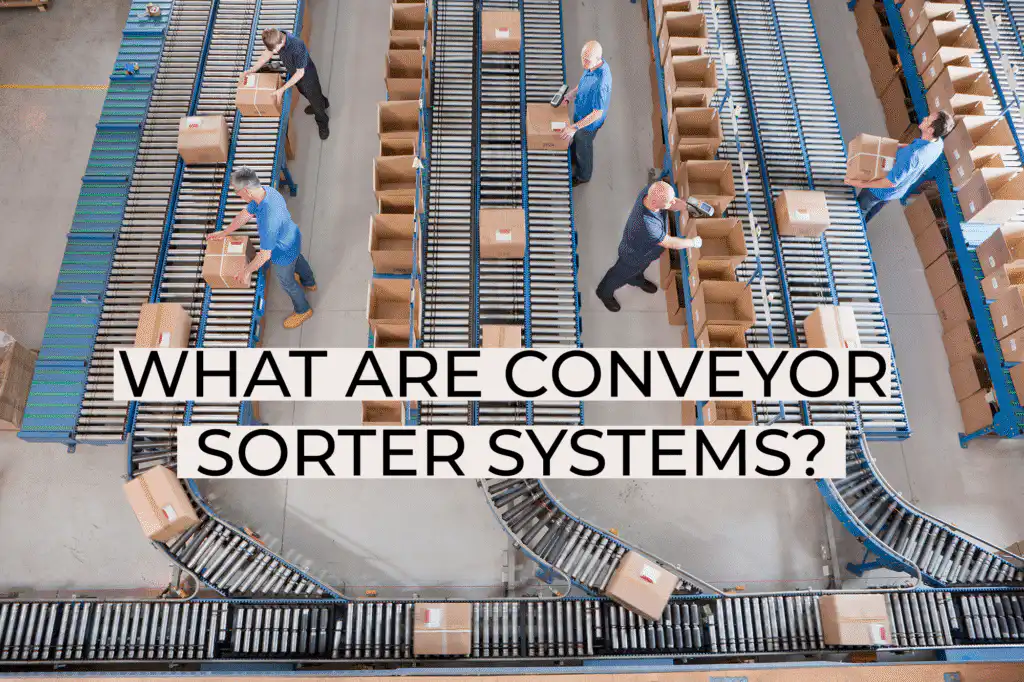
What are conveyor sorter systems?
[et_pb_section fb_built=”1″ _builder_version=”4.16″ _module_preset=”default” global_colors_info=”{}” theme_builder_area=”post_content”][et_pb_row _builder_version=”4.16″ _module_preset=”default” custom_padding=”|||14px||” global_colors_info=”{}” theme_builder_area=”post_content”][et_pb_column type=”4_4″ _builder_version=”4.16″ _module_preset=”default” global_colors_info=”{}” theme_builder_area=”post_content”][et_pb_text _builder_version=”4.27.4″ _module_preset=”default” custom_padding=”9px|24px|24px|23px||” hover_enabled=”0″ global_colors_info=”{}” theme_builder_area=”post_content” sticky_enabled=”0″]
What are conveyor sorter systems?
There are all sorts of contexts, from order fulfilment to manufacturing processes, where various items need to be sorted, often in their tens of thousands. Thankfully, these processes no longer need to be completed solely using manual labour – we also have access to tools such as conveyor sorter systems.
As with many other complicated logistics systems, it helps to have at least a rudimentary understanding of how they operate, to allow you to decide if they’re right for your business. With that in mind, let’s take a closer look at what conveyor sorters systems are, how they work, and where they can be useful.
A basic outline
Conveyor sorter systems essentially exist to take large quantities of different items and place them in their own categories. That could mean sorting large apples from smaller ones, separating car tyres by size, or pretty much any number of other similar functions.
They can be integrated into any number of different contexts, often logistical or manufacturing industries, massively increasing efficiency while also reducing the number of hands that need to be paid to complete incredibly simple, repetitive tasks.
How they work
Conveyor sorter systems from providers like Joloda Hydraroll can work in a number of different ways, depending on the item that needs to be sorted. Some will be able to assess the weight or size of objects that pass along a belt, pushing only those that fall within certain boundaries off into different sections.
Others will be able to automatically read barcodes, or scan RFID tags, to extract other pieces of data that inform where each item should be directed. These are just a couple of examples – there are many more besides these, and if you have more specific requirements, it’s worth contacting a specialist to see if there’s an option that could be more suitable.
[/et_pb_text][et_pb_divider _builder_version=”4.27.4″ _module_preset=”default” custom_margin=”-19px||3px|||” global_colors_info=”{}” theme_builder_area=”post_content”][/et_pb_divider][et_pb_code _builder_version=”4.27.4″ _module_preset=”default” hover_enabled=”0″ global_colors_info=”{}” theme_builder_area=”post_content” sticky_enabled=”0″]
Where they’re useful
Conveyor sorter systems can be incredibly useful pretty much anywhere that large quantities of items need to be sorted. Whether that’s in an industrial process, to store things in a warehouse, or in order to optimise an order fulfilment process, these sorter systems increase the rate at which these sorting processes can be taken care of while also decreasing the probability that human-error related sorting incidents will occur.
Choosing a solution
Rather than doing research to identify a solution on your own, it’s best to approach an automated sorting system specialist early on in the process. Outline your specific requirements, and they’ll be able to provide you with information on the available solutions, and how they might be able to further customise those to better suit your use-specific context.
If you think that you could probably benefit from some sort of conveyor sorting system, it’s worth exploring what’s available. You’ll likely be surprised at the operational specificity of some of the options that are available, and when approached in the right way, they can make a lot of industrial and logistics related processes almost infinitely more efficient, while also substantially reducing accidental damage and user error.
[/et_pb_text][et_pb_divider _builder_version=”4.27.4″ _module_preset=”default” custom_margin=”||9px|||” global_colors_info=”{}” theme_builder_area=”post_content”][/et_pb_divider][et_pb_code _builder_version=”4.27.4″ _module_preset=”default” global_colors_info=”{}” theme_builder_area=”post_content”]


Links
[/et_pb_text][/et_pb_column][et_pb_column type=”1_2″ _builder_version=”4.16″ global_colors_info=”{}” theme_builder_area=”post_content”][et_pb_text _builder_version=”4.16″ header_6_font=”Montserrat|700||on|||||” header_6_line_height=”1.8em” custom_margin=”||10px||false|false” locked=”off” global_colors_info=”{}” theme_builder_area=”post_content”]
Follow Us
[/et_pb_text][et_pb_social_media_follow icon_color=”#FFFFFF” _builder_version=”4.27.4″ _module_preset=”default” custom_button=”on” button_font=”Montserrat|||on|||||” text_orientation=”left” custom_margin=”4px|-41px|4px|-41px||” custom_padding=”9px|68px|9px|48px||” global_module=”100570″ saved_tabs=”all” global_colors_info=”{}” theme_builder_area=”post_content”][et_pb_social_media_follow_network social_network=”instagram” url=”https://www.instagram.com/broodmagazine” _builder_version=”4.20.2″ _module_preset=”default” background_color=”#ea2c59″ global_colors_info=”{}” theme_builder_area=”post_content” follow_button=”off” url_new_window=”on”]instagram[/et_pb_social_media_follow_network][et_pb_social_media_follow_network social_network=”facebook” url=”https://www.facebook.com/broodmagazine” _builder_version=”4.16″ _module_preset=”default” background_color=”#3b5998″ global_colors_info=”{}” theme_builder_area=”post_content” follow_button=”off” url_new_window=”on”]facebook[/et_pb_social_media_follow_network][et_pb_social_media_follow_network social_network=”linkedin” url=”http://www.linkedin.com/company/brood-magazine” _builder_version=”4.16″ _module_preset=”default” background_color=”#007bb6″ global_colors_info=”{}” theme_builder_area=”post_content” follow_button=”off” url_new_window=”on”]linkedin[/et_pb_social_media_follow_network][et_pb_social_media_follow_network social_network=”twitter” url=”https://www.twitter.com/broodmagazine1″ _builder_version=”4.22.2″ _module_preset=”default” background_color=”#000000″ global_colors_info=”{}” theme_builder_area=”post_content” follow_button=”off” url_new_window=”on”]twitter[/et_pb_social_media_follow_network][et_pb_social_media_follow_network social_network=”tiktok” url=”https://www.tiktok.com/@broodmagazine” _builder_version=”4.16″ _module_preset=”default” background_color=”#fe2c55″ global_colors_info=”{}” theme_builder_area=”post_content” follow_button=”off” url_new_window=”on”]tiktok[/et_pb_social_media_follow_network][et_pb_social_media_follow_network social_network=”youtube” url=”https://www.youtube.com/channel/UCzLh30eP7Tvcys8O6NG3LDA” _builder_version=”4.16″ _module_preset=”default” background_color=”#a82400″ global_colors_info=”{}” theme_builder_area=”post_content” follow_button=”off” url_new_window=”on”]youtube[/et_pb_social_media_follow_network][/et_pb_social_media_follow][/et_pb_column][/et_pb_row][/et_pb_section]