

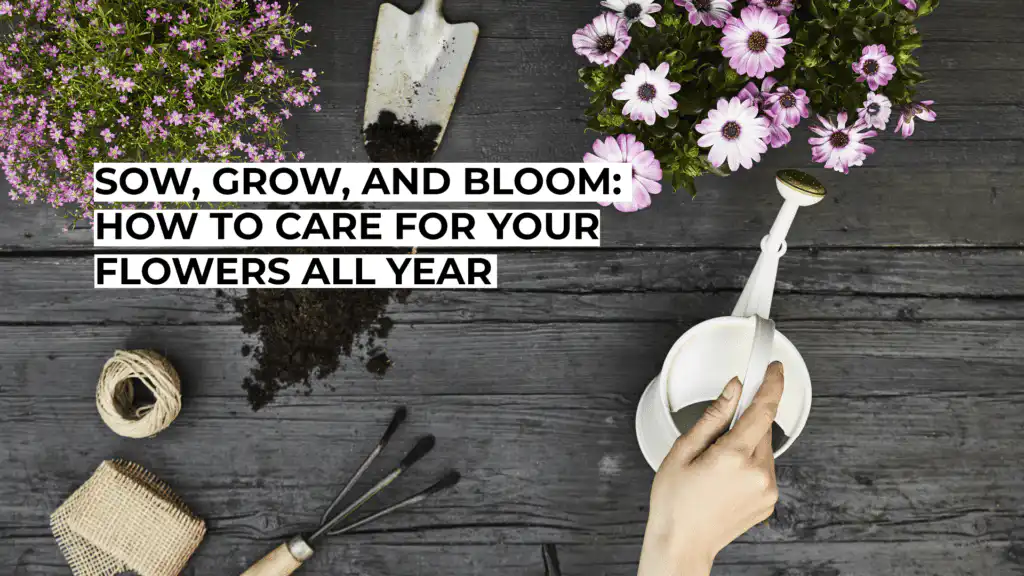
Sow, Grow, and Bloom: How to Care for Your Flowers All Year
[et_pb_section fb_built=”1″ _builder_version=”4.16″ _module_preset=”default” global_colors_info=”{}”][et_pb_row _builder_version=”4.16″ _module_preset=”default” custom_margin=”|auto|-13px|auto||” custom_padding=”|||14px||” global_colors_info=”{}”][et_pb_column type=”4_4″ _builder_version=”4.16″ _module_preset=”default” global_colors_info=”{}”][et_pb_text _builder_version=”4.27.5″ _module_preset=”default” custom_padding=”9px|24px|24px|23px||” hover_enabled=”0″ global_colors_info=”{}” sticky_enabled=”0″]
Sow, Grow, and Bloom: How to Care for Your Flowers All Year
Gardening’s one of those hobbies that really gives back, isn’t it? But here’s the thing – you can’t just chuck some seeds in the ground and hope for the best. If you want a proper show of flowers, you need to be there for them through every stage, from the moment you plant those tiny seeds right through to when they’re in full bloom. Whether you’ve been gardening for years or you’re just starting out, understanding what your flowers need throughout the year makes all the difference.
Before anything else, you need to pick the right seeds for your garden. Once you’ve got your favourites sorted, it’s all about giving them what they need as they grow. Here’s how to look after your flowers through the seasons.
Spring: The Season for Planting
Spring’s the ideal time to get your flower seeds in the ground. The soil’s warming up, and there’s less chance of frost catching you out. That said, you can’t just plant any old thing anywhere. Before you start, think about what’ll actually work in your garden. Some flowers are sun worshippers, whilst others prefer a bit of shade. Getting to know what your chosen flowers need will set them up properly from the start.
When you’re planting, make sure your soil drains well and has plenty of nutrients in it. It’s worth adding some compost or organic matter before you sow – your flowers will thank you for it. And do check the seed packet for planting depth. It sounds basic, but getting your seeds at the right level really matters.
Once they’re in, water them gently. You don’t want to wash everything about. Keep the soil consistently moist, but don’t drown it. Most flower seeds need regular watering, particularly if it’s dry. Just watch you don’t overdo it – soggy soil leads to root rot, and that’s the end of that.
Summer: Providing Care for Healthy Growth
When the weather properly warms up, your flowers will start growing like mad. During summer, you’re mainly focused on water, sunlight, and making sure they’ve got room to breathe. Keep that soil evenly moist, but again, don’t go overboard with the watering or you’ll drown the roots.
Most flowers want at least six hours of direct sun each day. If you’ve got yours in pots, pop them somewhere they’ll catch enough light. For flowers in the ground, just keep an eye out that they’re not being overshadowed by other plants.
Here’s something that’ll really help – deadhead regularly. That means snipping off the dead or fading blooms, which actually encourages the plant to make more flowers. It also stops them going to seed, so all their energy goes into new blooms instead. I know it can feel a bit tedious, but it keeps your garden looking tidy and the flowers coming.
[/et_pb_text][et_pb_image src=”https://broodmagazine.com/wp-content/uploads/2026/02/woman-touching-flowers-in-garden-2026-01-11-08-40-52-utc-scaled.webp” alt=”Seeds” title_text=”woman-touching-flowers-in-garden-2026-01-11-08-40-52-utc” _builder_version=”4.27.5″ _module_preset=”default” custom_padding=”||27px|||” hover_enabled=”0″ global_colors_info=”{}” sticky_enabled=”0″][/et_pb_image][et_pb_divider _builder_version=”4.27.4″ _module_preset=”default” custom_margin=”-19px||3px|||” global_colors_info=”{}”][/et_pb_divider][et_pb_text _builder_version=”4.27.5″ _module_preset=”default” custom_padding=”9px|24px|7px|23px||” global_colors_info=”{}”]
Sponsored Content:
[/et_pb_text][et_pb_code _builder_version=”4.27.5″ _module_preset=”default” global_colors_info=”{}”]


Autumn: Preparing for the Cooler Months
As things start cooling down in autumn, your flowers will naturally slow their growth. This is when you get them ready for winter. Annual flowers – the ones that only last one season – need to come out once they’ve finished. They won’t survive the cold, but you can save their seeds for next year if you like. Just let them dry out first before you collect them.
Perennials are different. Autumn’s the time to cut them back a bit, stopping them from getting too straggly. Plants like lavender or echinacea really benefit from a light trim at the end of the season. It keeps them compact and sets them up nicely for next year.
You might want to put down some mulch around the base of your plants as well. It protects the roots from frost by keeping the soil temperature more stable through winter. And do clear away any dead leaves or rubbish from the garden – they can harbour pests and diseases you don’t want hanging about.
Winter: Caring for Your Garden in the Cold Months
Winter can be tricky for gardeners, especially if you’re somewhere that gets properly cold. Still, plenty of hardy flowers can take it, and there are jobs you can do to keep your garden ticking over through the darker months.
For flowers that have gone dormant, keep the soil lightly moist. You won’t need to water nearly as much in winter, but don’t let it dry out completely either. If you get snow, it actually acts like a blanket and protects the plants. Just make sure they’re not being completely smothered under massive piles of it.
If your winters are particularly harsh, think about covering your flowers with horticultural fleece or frost cloths. You can also shift potted flowers to somewhere more sheltered, or bring them inside if that’s an option. Keep checking on them, and clear away any dead bits that might stop new growth coming through in spring.
Year-Round Maintenance Tips for a Thriving Flower Garden
Throughout the year, there are a few things you should build into your routine to keep your flowers healthy and looking their best. Check your plants regularly for pests or disease. Spot something? Deal with it quickly before it spreads. Natural remedies like neem oil or insecticidal soap work well and won’t harm your plants.
Make sure your flowers have enough space, too. When plants are crammed together, air can’t circulate properly, and that makes them more likely to get ill. If you’re using containers, check they’ve got drainage holes – you don’t want water sitting at the bottom.
One more thing worth trying is companion planting. Some plants genuinely help each other out when they’re grown together. Marigolds near tomatoes, for instance, help keep pests
[/et_pb_text][et_pb_divider _builder_version=”4.27.4″ _module_preset=”default” custom_margin=”||9px|||” custom_padding=”1px||0px|||” global_colors_info=”{}”][/et_pb_divider][et_pb_text _builder_version=”4.27.5″ _module_preset=”default” custom_margin=”-13px|||||” custom_padding=”9px|24px|7px|23px||” global_colors_info=”{}”]
Sponsored Content:
[/et_pb_text][et_pb_code _builder_version=”4.27.5″ _module_preset=”default” global_colors_info=”{}”]


Links
[/et_pb_text][/et_pb_column][et_pb_column type=”1_2″ _builder_version=”4.16″ global_colors_info=”{}”][et_pb_text _builder_version=”4.16″ header_6_font=”Montserrat|700||on|||||” header_6_line_height=”1.8em” custom_margin=”||10px||false|false” locked=”off” global_colors_info=”{}”]
Follow Us
[/et_pb_text][et_pb_social_media_follow icon_color=”#FFFFFF” _builder_version=”4.27.5″ _module_preset=”default” custom_button=”on” button_font=”Montserrat|||on|||||” text_orientation=”center” custom_margin=”4px|-41px|4px|-41px||” custom_padding=”9px|68px|9px|48px||” global_module=”100570″ saved_tabs=”all” global_colors_info=”{}”][et_pb_social_media_follow_network social_network=”instagram” url=”https://www.instagram.com/broodmagazine” _builder_version=”4.20.2″ _module_preset=”default” background_color=”#ea2c59″ global_colors_info=”{}” follow_button=”off” url_new_window=”on”]instagram[/et_pb_social_media_follow_network][et_pb_social_media_follow_network social_network=”facebook” url=”https://www.facebook.com/broodmagazine” _builder_version=”4.16″ _module_preset=”default” background_color=”#3b5998″ global_colors_info=”{}” follow_button=”off” url_new_window=”on”]facebook[/et_pb_social_media_follow_network][et_pb_social_media_follow_network social_network=”linkedin” url=”http://www.linkedin.com/company/brood-magazine” _builder_version=”4.16″ _module_preset=”default” background_color=”#007bb6″ global_colors_info=”{}” follow_button=”off” url_new_window=”on”]linkedin[/et_pb_social_media_follow_network][et_pb_social_media_follow_network social_network=”twitter” url=”https://www.twitter.com/broodmagazine1″ _builder_version=”4.22.2″ _module_preset=”default” background_color=”#000000″ global_colors_info=”{}” follow_button=”off” url_new_window=”on”]twitter[/et_pb_social_media_follow_network][et_pb_social_media_follow_network social_network=”tiktok” url=”https://www.tiktok.com/@broodmagazine” _builder_version=”4.16″ _module_preset=”default” background_color=”#fe2c55″ global_colors_info=”{}” follow_button=”off” url_new_window=”on”]tiktok[/et_pb_social_media_follow_network][et_pb_social_media_follow_network social_network=”youtube” url=”https://www.youtube.com/channel/UCzLh30eP7Tvcys8O6NG3LDA” _builder_version=”4.16″ _module_preset=”default” background_color=”#a82400″ global_colors_info=”{}” follow_button=”off” url_new_window=”on”]youtube[/et_pb_social_media_follow_network][/et_pb_social_media_follow][/et_pb_column][/et_pb_row][/et_pb_section]