

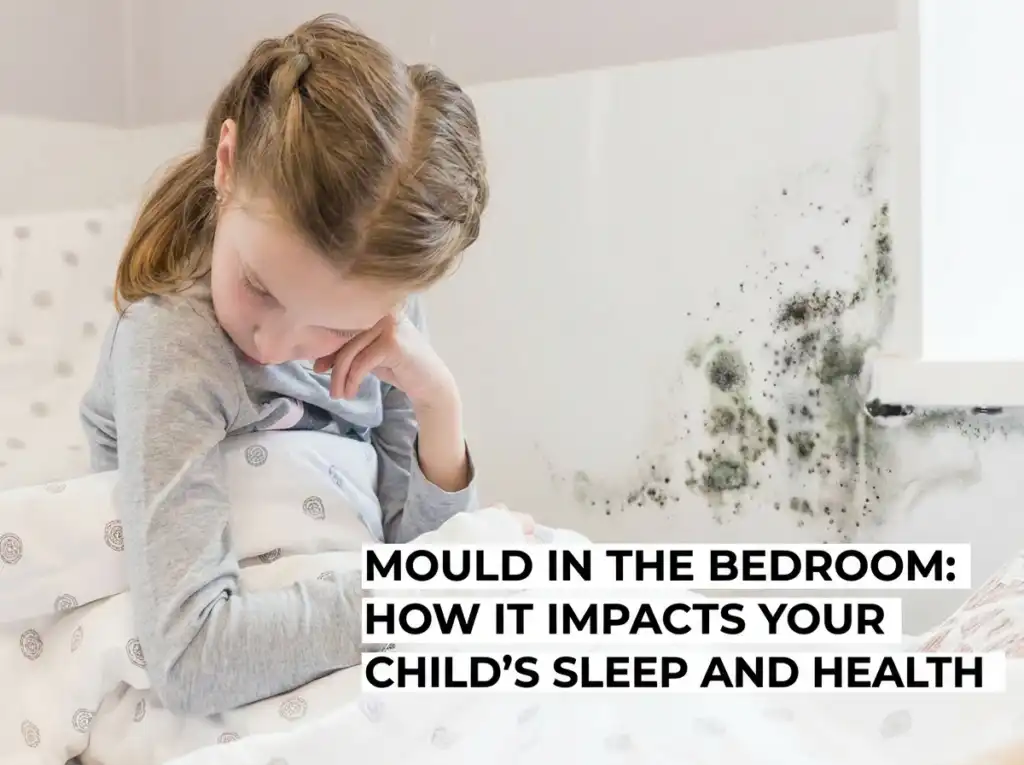
Mould in the Bedroom: How It Impacts Your Child’s Sleep and Health
[et_pb_section fb_built=”1″ _builder_version=”4.16″ _module_preset=”default” global_colors_info=”{}”][et_pb_row _builder_version=”4.16″ _module_preset=”default” custom_padding=”|||14px||” global_colors_info=”{}”][et_pb_column type=”4_4″ _builder_version=”4.16″ _module_preset=”default” global_colors_info=”{}”][et_pb_text _builder_version=”4.27.5″ _module_preset=”default” custom_padding=”9px|24px|24px|23px||” global_colors_info=”{}”]
Mould in the Bedroom: How It Impacts Your Child’s Sleep and Health
Finding a patch of damp or dark spots on a bedroom wall is a common worry for many parents. Because children spend a significant portion of their day sleeping, the air quality in their bedroom is vital for their development. When mould begins to grow, it’s a biological hazard that can disrupt their rest and long-term wellbeing.
The presence of mould often indicates underlying issues with ventilation or insulation. If you’ve spotted fuzzy growth on the back of a wardrobe or near a window frame, you shouldn’t ignore it. Understanding the specific risks involved can help you take the right steps to protect your family. Read on to discover how this household fungus affects your little ones and what you can do about it.
The Connection Between Mould and Sleep Quality
Mould releases microscopic spores and volatile organic compounds into the air, which can be easily inhaled during the night. For a child, this exposure often leads to nasal congestion, sneezing, and a persistent cough. When a child’s airways are irritated, they’ll likely struggle to fall asleep or may wake up frequently throughout the night.
If your child’s sleep is constantly interrupted by respiratory discomfort, it’s worth investigating the corners of their room. Specialist teams like ICE Cleaning offer comprehensive surveys to identify the root cause of these issues. Addressing the problem early ensures that the environment remains conducive to deep, restorative rest.
How Mould Impacts a Child
Restless Nights and Daytime Fatigue
A child who doesn’t sleep well because of poor air quality will most likely still be tired after a night’s rest. They might also become irritable or struggle to concentrate at school. You may notice they’re more lethargic than usual or seem to have a permanent cold that never quite clears up.
These symptoms are often the body’s reaction to the allergens produced by indoor fungi.
[/et_pb_text][et_pb_image src=”https://broodmagazine.com/wp-content/uploads/2026/02/Mould-in-the-Bedroom-How-It-Impacts-Your-Childs-Sleep-and-Health.webp” alt=”Mould in the Bedroom: How It Impacts Your Child’s Sleep and Health” title_text=”Mould in the Bedroom – How It Impacts Your Child’s Sleep and Health” _builder_version=”4.27.5″ _module_preset=”default” custom_padding=”||27px|||” global_colors_info=”{}”][/et_pb_image][et_pb_divider _builder_version=”4.27.4″ _module_preset=”default” custom_margin=”-19px||3px|||” global_colors_info=”{}”][/et_pb_divider][et_pb_code _builder_version=”4.27.5″ _module_preset=”default” global_colors_info=”{}”]

How Mould Affects Respiratory Health
Children have smaller airways and developing immune systems, making them far more vulnerable to damp environments than adults. Prolonged exposure can lead to the development of chronic conditions. Experts have often linked living in damp, mouldy homes to a higher risk of childhood asthma and allergic rhinitis.
- Wheezing and Coughing: Persistent irritation of the lungs can cause audible wheezing.
- Skin Irritations: In some cases, spores can trigger eczema flare-ups or itchy skin rashes.
- Eye Irritation: Red, watery, or itchy eyes are common signs of an allergic reaction to spores.
- Weakened Immunity: Constant exposure means the immune system is always on guard, potentially making children more susceptible to other infections.
Creating a Healthier Sleeping Environment
A quick wipe with a cloth is not enough to stop mould. To keep the bedroom safe, crucially, you must control the moisture levels. In the UK, condensation is a major culprit, especially during the colder months when we keep windows closed and the heating on.
- Improve Ventilation: Open windows for at least ten minutes every morning to let fresh air circulate.
- Monitor Humidity: Keep indoor humidity levels between 30% and 50% using a hygrometer.
- Clear Space: Don’t push furniture directly against external walls; leave a gap so air can flow behind wardrobes and beds.
- Dry Clothes Outside: Avoid drying laundry on radiators inside the bedroom, as this releases significant moisture into the air.
The Bottom Line
It’s clear that a damp bedroom is not just a minor inconvenience. Because mould impacts everything from physical lung health to the quality of a child’s sleep, it’s something every parent needs to take seriously. Taking proactive steps to dry out your home and improve airflow will make a world of difference to your child’s daily energy and long-term health.
If you’ve discovered a significant growth, don’t try to scrub it away yourself, as this can often spread the spores further. Seeking professional mould removal assistance ensures the fungus is eradicated safely and won’t return to haunt your child’s dreams.
[/et_pb_text][et_pb_divider _builder_version=”4.27.4″ _module_preset=”default” custom_margin=”||9px|||” global_colors_info=”{}”][/et_pb_divider][et_pb_code _builder_version=”4.27.5″ _module_preset=”default” custom_padding=”0px|||||” global_colors_info=”{}”]


Links
[/et_pb_text][/et_pb_column][et_pb_column type=”1_2″ _builder_version=”4.16″ global_colors_info=”{}”][et_pb_text _builder_version=”4.16″ header_6_font=”Montserrat|700||on|||||” header_6_line_height=”1.8em” custom_margin=”||10px||false|false” locked=”off” global_colors_info=”{}”]
Follow Us
[/et_pb_text][et_pb_social_media_follow icon_color=”#FFFFFF” _builder_version=”4.27.5″ _module_preset=”default” custom_button=”on” button_font=”Montserrat|||on|||||” text_orientation=”center” custom_margin=”4px|-41px|4px|-41px||” custom_padding=”9px|68px|9px|48px||” global_module=”100570″ saved_tabs=”all” global_colors_info=”{}”][et_pb_social_media_follow_network social_network=”instagram” url=”https://www.instagram.com/broodmagazine” _builder_version=”4.20.2″ _module_preset=”default” background_color=”#ea2c59″ global_colors_info=”{}” follow_button=”off” url_new_window=”on”]instagram[/et_pb_social_media_follow_network][et_pb_social_media_follow_network social_network=”facebook” url=”https://www.facebook.com/broodmagazine” _builder_version=”4.16″ _module_preset=”default” background_color=”#3b5998″ global_colors_info=”{}” follow_button=”off” url_new_window=”on”]facebook[/et_pb_social_media_follow_network][et_pb_social_media_follow_network social_network=”linkedin” url=”http://www.linkedin.com/company/brood-magazine” _builder_version=”4.16″ _module_preset=”default” background_color=”#007bb6″ global_colors_info=”{}” follow_button=”off” url_new_window=”on”]linkedin[/et_pb_social_media_follow_network][et_pb_social_media_follow_network social_network=”twitter” url=”https://www.twitter.com/broodmagazine1″ _builder_version=”4.22.2″ _module_preset=”default” background_color=”#000000″ global_colors_info=”{}” follow_button=”off” url_new_window=”on”]twitter[/et_pb_social_media_follow_network][et_pb_social_media_follow_network social_network=”tiktok” url=”https://www.tiktok.com/@broodmagazine” _builder_version=”4.16″ _module_preset=”default” background_color=”#fe2c55″ global_colors_info=”{}” follow_button=”off” url_new_window=”on”]tiktok[/et_pb_social_media_follow_network][et_pb_social_media_follow_network social_network=”youtube” url=”https://www.youtube.com/channel/UCzLh30eP7Tvcys8O6NG3LDA” _builder_version=”4.16″ _module_preset=”default” background_color=”#a82400″ global_colors_info=”{}” follow_button=”off” url_new_window=”on”]youtube[/et_pb_social_media_follow_network][/et_pb_social_media_follow][/et_pb_column][/et_pb_row][/et_pb_section]