

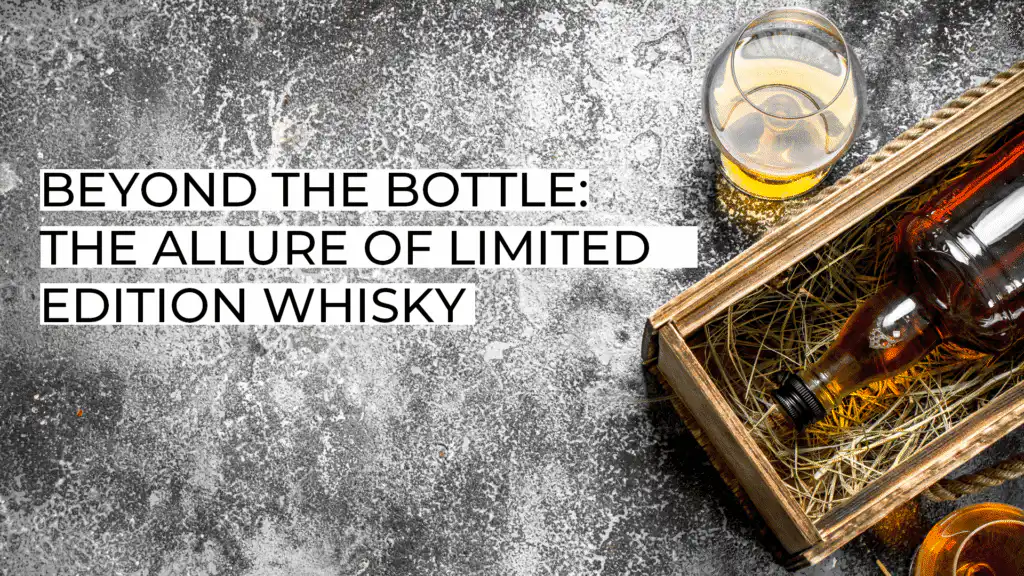
Beyond the Bottle: The Allure of Limited Edition Whisky
[et_pb_section fb_built=”1″ _builder_version=”4.16″ _module_preset=”default” global_colors_info=”{}” theme_builder_area=”post_content”][et_pb_row _builder_version=”4.16″ _module_preset=”default” custom_padding=”|||14px||” global_colors_info=”{}” theme_builder_area=”post_content”][et_pb_column type=”4_4″ _builder_version=”4.16″ _module_preset=”default” global_colors_info=”{}” theme_builder_area=”post_content”][et_pb_text _builder_version=”4.27.4″ _module_preset=”default” custom_padding=”9px|24px|24px|23px||” hover_enabled=”0″ global_colors_info=”{}” theme_builder_area=”post_content” sticky_enabled=”0″]
Beyond the Bottle: The Allure of Limited Edition Whisky
Whisky exists on a spectrum between mass-produced consistency and artisanal singularity. Standard expressions aim for reliable uniformity, the same flavour profile year after year. Limited editions, by contrast, celebrate deviation, offering snapshots of unique moments in a distillery’s creative journey. These bottles capture fleeting experiments, exceptional casks, or bold creative visions that defy commercial constraints.
The Alchemy of Exclusivity
What defines a limited edition whisky isn’t just scarcity, but intentional distinction. While regular releases prioritize broad appeal, limited runs might showcase unusual cask finishes (Japanese umeshu barrels, anyone?), higher age statements, or resurrected historical recipes. The Glenmorangie A Tale of Cake series, for instance, employed dessert wine casks to create flavours mainstream bottlings wouldn’t risk.
Craft Over Convenience
Production methods diverge sharply. Core range whiskies often blend hundreds of casks for consistency, while limited editions might bottle a single extraordinary barrel. Smaller batches allow for hands-on attention, distillers might rotate casks more frequently, use bespoke char levels, or employ discontinued yeast strains. This craftsmanship translates to bottles with individual personalities rather than corporate homogeneity.
The Collector’s Equation
Investment potential separates limited editions from shelf staples. Rare releases like Macallan’s Lalique series appreciate exponentially, transforming liquor cabinets into alternative asset portfolios. However, true value lies beyond money, these bottles commemorate milestones, from anniversaries to master distiller retirements, carrying narratives standard releases can’t match.
Sensory Adventure Awaits
Flavour profiles push boundaries in limited runs. Where a distillery’s 12-year-old offers reliable maltiness, their limited edition might marry peated and unpeated spirits or finish in unexpected woods like acacia or chestnut. Bunnahabhain’s limited releases, for example, explore extremes of cask influence that would destabilize their core range’s identity.
[/et_pb_text][et_pb_image src=”https://broodmagazine.com/wp-content/uploads/2025/08/Limited-Edition-Whiskeys.webp” alt=”Limited eduiition whiskeys” title_text=”Glasses of the whiskey with a square decanter” align=”center” _builder_version=”4.27.4″ _module_preset=”default” hover_enabled=”0″ global_colors_info=”{}” theme_builder_area=”post_content” sticky_enabled=”0″][/et_pb_image][et_pb_divider _builder_version=”4.27.4″ _module_preset=”default” custom_margin=”-19px||3px|||” global_colors_info=”{}” theme_builder_area=”post_content”][/et_pb_divider][et_pb_code _builder_version=”4.27.4″ _module_preset=”default” global_colors_info=”{}” theme_builder_area=”post_content”]
The Packaging Paradox
Limited editions engage multiple senses before the cork’s pulled. Heavy glass, intricate labels, and custom cases, like Ardbeg’s sculptural Arrrrrrrrdbeg! bottle, elevate the experience from drinking to ritual. This theatricality isn’t mere marketing; it signals that what’s inside deserves special attention.
The Time Capsule Effect
Unlike perpetual expressions, limited editions freeze moments in whisky’s evolution. Springbank’s annual Local Barley series documents changing harvests, while Yamazaki’s single cask releases preserve unique microclimates from specific warehouse corners. These become liquid archives of a distillery’s ongoing story.
The Community Catalyst
Scarcity fosters connection among enthusiasts. Hunting rare bottles builds camaraderie, while shared tastings of limited releases turn strangers into fellow explorers. Online forums buzz with debates over whether Diageo’s Special Releases justify their premiums, conversations that rarely surround everyday malts.
The Authenticity Advantage
Limited editions often escape corporate dilution. Independent bottlers like Gordon & MacPhail offer single casks untouched by focus groups, while distilleries use small batches to revive discontinued styles (remember Port Ellen’s resurrection?). These bottles represent whisky at its most unapologetic.
To Open or Not to Open?
Herein lies the existential question. While collectors hoard sealed bottles, limited editions reward drinking, their unconventional flavors demand engagement. Compromise exists: share special bottles with friends who’ll appreciate them, preserving the memory beyond resale value.
Limited editions aren’t inherently superior, just different. They’re the jazz improvisations to core range’s classical symphonies; both have merit, but one offers surprises the other can’t. For novices, they provide gateways into whisky’s infinite variety. For connoisseurs, they’re reminders that no matter how much you’ve tasted, there’s always something new under the cork.
[/et_pb_text][et_pb_divider _builder_version=”4.27.4″ _module_preset=”default” custom_margin=”||9px|||” global_colors_info=”{}” theme_builder_area=”post_content”][/et_pb_divider][et_pb_code _builder_version=”4.27.4″ _module_preset=”default” global_colors_info=”{}” theme_builder_area=”post_content”]

Links
[/et_pb_text][/et_pb_column][et_pb_column type=”1_2″ _builder_version=”4.16″ global_colors_info=”{}” theme_builder_area=”post_content”][et_pb_text _builder_version=”4.16″ header_6_font=”Montserrat|700||on|||||” header_6_line_height=”1.8em” custom_margin=”||10px||false|false” locked=”off” global_colors_info=”{}” theme_builder_area=”post_content”]
Follow Us
[/et_pb_text][et_pb_social_media_follow icon_color=”#FFFFFF” _builder_version=”4.27.4″ _module_preset=”default” custom_button=”on” button_font=”Montserrat|||on|||||” text_orientation=”left” custom_margin=”4px|-41px|4px|-41px||” custom_padding=”9px|68px|9px|48px||” global_module=”100570″ saved_tabs=”all” global_colors_info=”{}” theme_builder_area=”post_content”][et_pb_social_media_follow_network social_network=”instagram” url=”https://www.instagram.com/broodmagazine” _builder_version=”4.20.2″ _module_preset=”default” background_color=”#ea2c59″ global_colors_info=”{}” theme_builder_area=”post_content” follow_button=”off” url_new_window=”on”]instagram[/et_pb_social_media_follow_network][et_pb_social_media_follow_network social_network=”facebook” url=”https://www.facebook.com/broodmagazine” _builder_version=”4.16″ _module_preset=”default” background_color=”#3b5998″ global_colors_info=”{}” theme_builder_area=”post_content” follow_button=”off” url_new_window=”on”]facebook[/et_pb_social_media_follow_network][et_pb_social_media_follow_network social_network=”linkedin” url=”http://www.linkedin.com/company/brood-magazine” _builder_version=”4.16″ _module_preset=”default” background_color=”#007bb6″ global_colors_info=”{}” theme_builder_area=”post_content” follow_button=”off” url_new_window=”on”]linkedin[/et_pb_social_media_follow_network][et_pb_social_media_follow_network social_network=”twitter” url=”https://www.twitter.com/broodmagazine1″ _builder_version=”4.22.2″ _module_preset=”default” background_color=”#000000″ global_colors_info=”{}” theme_builder_area=”post_content” follow_button=”off” url_new_window=”on”]twitter[/et_pb_social_media_follow_network][et_pb_social_media_follow_network social_network=”tiktok” url=”https://www.tiktok.com/@broodmagazine” _builder_version=”4.16″ _module_preset=”default” background_color=”#fe2c55″ global_colors_info=”{}” theme_builder_area=”post_content” follow_button=”off” url_new_window=”on”]tiktok[/et_pb_social_media_follow_network][et_pb_social_media_follow_network social_network=”youtube” url=”https://www.youtube.com/channel/UCzLh30eP7Tvcys8O6NG3LDA” _builder_version=”4.16″ _module_preset=”default” background_color=”#a82400″ global_colors_info=”{}” theme_builder_area=”post_content” follow_button=”off” url_new_window=”on”]youtube[/et_pb_social_media_follow_network][/et_pb_social_media_follow][/et_pb_column][/et_pb_row][/et_pb_section]