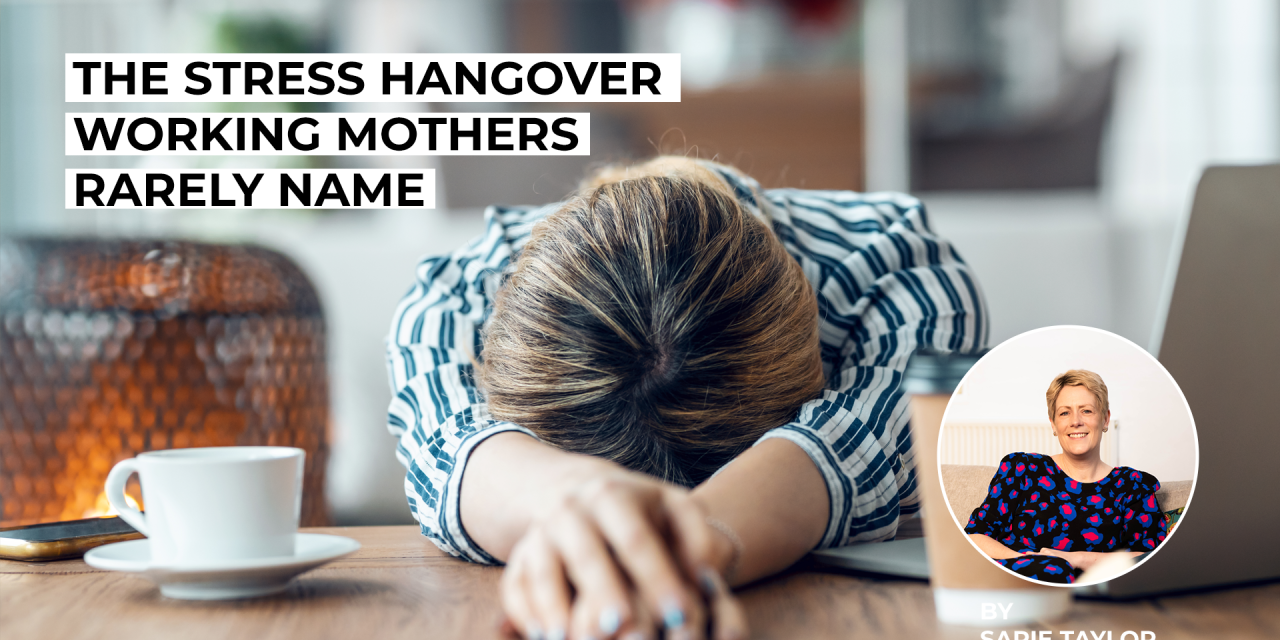
The Stress Hangover Working Mothers Rarely Name
By Sarie Taylor
If you’re a working parent, and especially if you’re a woman, you’ve likely become exceptionally skilled at holding things together and feeling that a lot of responsibility falls on you.
You manage deadlines and dinner. You switch between strategic thinking and emotional caretaking in the space of minutes. You absorb tension in meetings and soothe it at bedtime. You remember the school trip form, the client follow-up, the birthday present, the food shop, the subtle shift in your child’s mood. Much of what you carry is invisible, but it can be constant.
From the outside, you appear capable and composed. You are the reliable one and often the one who “just gets on with it.” And then, usually when everything looks fine, your body responds. This can show up in many different ways.
A headache that won’t quite lift. A wave of exhaustion that feels disproportionate to the day. A tight chest while you’re unloading the dishwasher. Hot flushes. (Or maybe that’s just me!) Brain fog. A flat, heavy feeling that makes even small tasks feel like hard work. Sometimes it arrives with a quiet judgment: What’s wrong with me? I was doing so well. Everyone else seems to manage.
Sarie Taylor is a formidable mum of two, a trained psychotherapist and a life coach who works with people across the world with a wide range of issues.
Having suffered with severe anxiety for many years herself, Sarie also has personal experience and an understanding of what it feels like to struggle.
Insta: @sarietaylorcoaching
www.worldwidewellbeing.co.uk
The real shift isn’t eliminating discomfort — it’s learning that you can feel it without believing you’re failing.
Many women assume this means they aren’t coping as well as they thought, or that they should be stronger, more resilient, better at managing their time, their mindset, their hormones, their boundaries, it’s never ending!
But what if none of that is true?
What if what you’re experiencing isn’t failure but actually physiology?
The Invisible “Second Shift” in Your Nervous System
There’s a phrase often used to describe working motherhood: the second shift. The unpaid, unseen labour that begins when the formal workday ends, and there’s another second shift that rarely gets named the one happening internally.
Throughout the day, your nervous system is constantly responding to perceived demand. It’s responding to the physical demand, and also the emotional and cognitive demand. The meeting that we believe really matters, the difficult conversations, the background noise of logistics: pick-ups, meals, messages, appointments.
We can find that sometimes we manage these moments really well as we seem to stay composed, problem solving, you just keep moving. We don’t always realise though that coping in the moment doesn’t mean your system isn’t activated.
Often, your body mobilises quietly to help you meet the demand. What does that even mean though? Stress hormones rise, muscles brace subtly, your world shrinks, you become focused and efficient which from the outside, it looks like strength.
Then the deadline passes. The children are in bed. The house quiets. And instead of relief, you feel depleted.
This is what I call a stress hangover; it’s the after-effect of sustained internal activation that often only becomes visible once you finally pause. The body releasing what it held while you were busy surviving the day.
It doesn’t show up during the crisis.
It shows up after.
And because it arrives late, many women misinterpret it.
When Discomfort Feels Like Danger
The physical sensations themselves are rarely the full story. What intensifies them is the meaning layered on top, the thoughts that you have about yourself that you believe to be true. If you had a racing heart at the gym its interpreted be true. If you had a racing heart at the gym its interpreted as exertion and yet the same sensation at 3am. can be interpreted as threat. The body hasn’t changed, just the story has.
Your exhaustion may not be evidence that you’re doing life badly.
It may be evidence that you’ve been doing it bravely.
Working mothers are often running a quiet narrative beneath the surface: I have to hold this together. When a symptom appears like fatigue, anxiety, irritability, it can feel like evidence that you’re dropping the ball somewhere and that you’re not managing as well as you thought. That something is wrong.
The mind begins scanning. Analysing. Predicting.
Am I burning out? Is this hormones?
Am I failing at work?
Am I being unfair to my kids?
The moment your system registers danger, even conceptually, it stays on alert and you may find you monitor the sensation, resisting it and trying to fix it quickly.
Ironically, that urgency prolongs the very activation you want to end.
Your nervous system isn’t malfunctioning. It’s responding intelligently to the interpretation it’s given.
The Hidden Cost of Being the Capable One
Modern motherhood, particularly for women who also work, carries an unspoken expectation of seamless performance, being ambitious but available. Driven but present. Successful but selfless. Organised but relaxed. That balancing act requires a tremendous amount of internal and unrealistic management.
When life is powered by low-level urgency, everything feels slightly more important than it needs to be, you may recognise this when small problems feel heavy and rest feels indulgent rather than necessary. Asking for help can feel inefficient or like an admission of weakness and even your downtime (if you are lucky enough to get it!) is often filled with mental planning.
You become highly functional.
But rarely deeply rested.
Over time, the nervous system begins to live in a subtly alert state, not necessarily panicked even just quietly on guard. When the body doesn’t get regular opportunities to reset, it will eventually demand one and make it a non-negotiable. This isn’t a punishment or a sign you are failing it’s simply that your system requires and will seek out balance always.
Neutral Is Not Boring — It’s Powerful
We often assume the ideal state of being is energised, productive, and enthusiastic but the most sustainable state for a working parent is something far less glamorous: neutral. When we are much more neutral and grounded moment to moment, we feel steady, clear and can respond without being too reactive. In a neutral state, you can hear yourself thinking for me I know I experience everything from a much more enjoyable and comfortable space, for example I can tolerate my three year old child’s meltdown without absorbing it as a personal failure, I can approach a difficult email without my stomach flipping and I can rest without feeling guilty.
Neutral is where wisdom and gut instinct lives.
And it’s also where your nervous system recalibrates.
Peace isn’t the absence of responsibility, but it is the absence of unnecessary internal pressure.
Rethinking the Goal
Many women tell me they just want to “cope better.” But beneath that is often a deeper desire: to never feel this way again.
No one can promise a life without discomfort, as hormones will fluctuate, children will have hard phases and work and life will bring challenges. The real shift isn’t in eliminating those experiences but rather seeing that you can feel discomfort without making it mean you are unsafe, incapable, or failing.
You can experience activation without spiralling.
You can be tired without being broken.
That understanding changes the relationship you have with your own nervous system and when that relationship softens, the system itself often follows. If you recognise yourself as the capable one, the reliable one, the woman who keeps everything moving, consider this a gentle reframe.
Your exhaustion may not be evidence that you’re doing life badly.
It may be evidence that you’ve been doing it bravely.
Your nervous system is not your enemy. It is your operating system. And it deserves the same care and attention you so readily give to everyone else.
This is what I call a stress hangover — the after-effect of sustained internal activation that often only becomes visible once you finally pause. It doesn’t show up during the crisis. It shows up after.




KEEP UP TO DATE WITH BROOD:
Related Articles
Why Learning a Language as a Busy Parent Is One of the Best Things You Can Do (And How to Actually Make It Happen)
Travel Why Learning a Language as a Busy Parent Is One of the Best Things You Can Do (And How to Actually Make It Happen) No classroom. No fixed timetable. Just you, a real tutor, and a skill that'll stick around for life. When was the last time you did something...

Ibiza Comes to London: Why the Alto x Cotton Beach Club Collab Belongs on Every Parent’s Night-Off List
Ibiza isn’t on the cards for most of us this summer — but that doesn’t mean you can’t get a taste of it. Alto by San Carlo has partnered with the iconic Cotton Beach Club Ibiza for two exclusive evenings on the rooftop of Selfridges, London. Think sun-soaked Mediterranean food, live DJ sets, Champagne and London’s skyline as your backdrop. Two dates only — and honestly? You deserve this one.

Lisa Johnson: From £30K Debt to Multi-Millionaire – How a Mum of Two Built a Freedom-Focused Business
Discover how Lisa Johnson, award-winning entrepreneur and mum of twins, went from £30,000 in debt to building a multi-million-pound business in just seven years. In this exclusive interview, Lisa shares her journey through adversity, her strategies for scaling with passive income, and her honest advice for parents and entrepreneurs seeking financial freedom, work-life balance, and lasting impact. Keywords: Lisa Johnson, entrepreneur, passive income, business strategy, work-life balance, financial freedom, mumpreneur, online business, success story.
School Holiday Jigsaw: Surviving the Summer Holidays as a Working Parent
School Holiday Jigsaw: Surviving the Summer Holidays as a Working Parent
For school children, the six-week break is a magical expanse of unstructured freedom. For working parents, it marks the beginning of a military-grade logistical operation. Between the skyrocketing costs of summer camps, tag-teaming annual leave with partners, and attempting the ultimate high-wire act of working from home with a laptop on your knee, the math of July and August simply doesn’t add up. We dive deep into the reality of trying to fit a 19th-century agricultural school calendar into a 21st-century digital economy—and explore the progressive workplace shifts needed to save our sanity.

The Cognitive Crutch: Are We Outsourcing Our kid’s Brains to AI?
The Cognitive Crutch: Are We Outsourcing Our Children’s Brains to AI?
Generative AI has transitioned from a novel tech trend to a permanent classroom fixture. But as tools like ChatGPT effortlessly handle the heavy cognitive lifting of writing essays and solving equations, educators and neuroscientists are raising an urgent alarm. True learning is rooted in the cognitive friction of arriving at an answer. By outsourcing that struggle to machines, are we causing intellectual stamina to atrophy, leaving behind a generation of brilliant curators who have lost the ability to think independently? From primary schools to university campuses, the data reveals a stark shift from active learning to passive “cognitive offloading.”

The Big 2026 British Playcation: The Ultimate Free, Low-Cost & Premium Summer Days Out
The six-week school summer holidays are here, but keeping kids entertained shouldn’t break the bank. With new data showing a massive “play gap” across the UK, we’ve rounded up 11 of the absolute best national initiatives, free community festivals, heavily discounted active-play passes, and premium family adventures to help you balance the budget while creating unforgettable summer memories.

Why the UK is Suddenly Going All Out for Graduation Season
Discover why British graduations are becoming massive lifestyle events and explore San Carlo’s new summer menu—the perfect way to celebrate in style.
New ‘xV’ Campaign Launches “The Unspoken Stat” to Expose Hidden Domestic Abuse Spike Around England Matches
A powerful new World Cup campaign introduces “xV” (Expected Violence) to expose a chilling reality: research shows domestic abuse incidents spike by 38% when England loses and 26% even when they win. Backed by survivors, sports figures, and celebrities like Mel B, the campaign demands that this hidden statistic receives the same urgent attention as modern football data.

Banning Social Media Under 16: What the New UK Law Means for Parents
The UK government has announced a landmark social media ban for children under 16. From affected apps to enforcement timelines, here is what the “Australia Plus” model means for busy working parents and family life.

Beat The Heat: Top Tips To Help Your Kids Sleep During A Heatwave
Struggling to get your little ones to sleep in a stifling bedroom? From clever daytime blackout tactics and safe on-the-go shading with SnoozeShade, to expert routine adjustments from pediatric sleep specialist Amanda Marks and soothing audio tracks from Bedtime Story Co, we’ve got your ultimate guide to keeping kids cool, calm, and safely asleep during a summer scorcher.
10 Business Processes Every Founder Should Automate First
WORK 10 Business Processes Every Founder Should Automate First Founders juggling a growing business and a busy household hardly have spare hours to lose. Every task done manually is time taken away from decisions that actually need attention, or from the people...
How to Make a Student Laptop Last Longer
Discover expert-backed hacks for extending a laptop’s lifespan and avoiding shelling out for a costly replacement.
Why Learning a Language as a Busy Parent Is One of the Best Things You Can Do (And How to Actually Make It Happen)
Travel Why Learning a Language as a Busy Parent Is One of the Best Things You Can Do (And How to Actually Make It Happen) No classroom. No fixed timetable. Just you, a real tutor, and a skill that'll stick around for life. When was the last time you did something...