

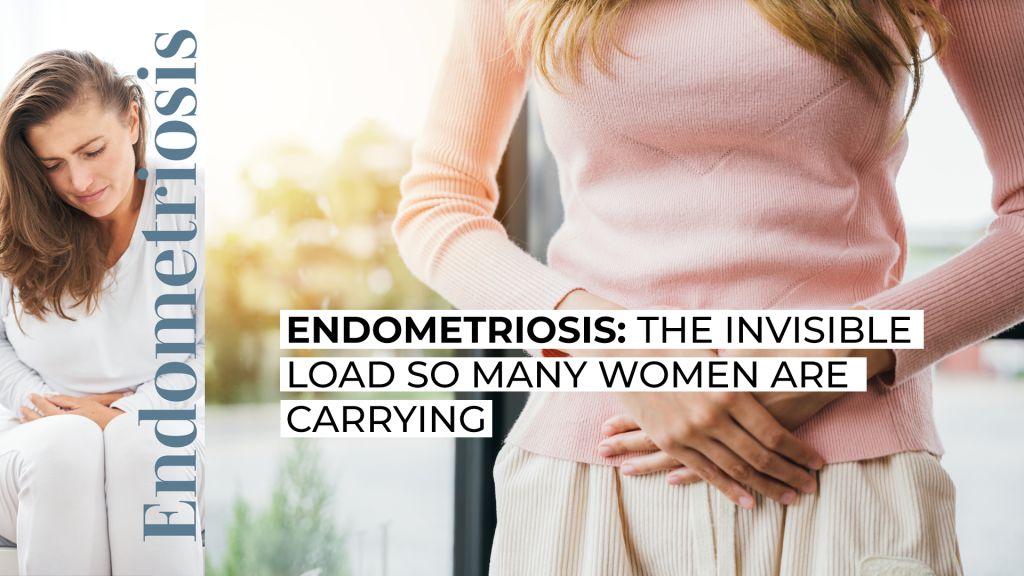
Endometriosis: The Invisible Load so many women are carrying
[et_pb_section fb_built=”1″ _builder_version=”4.16″ _module_preset=”default” custom_padding=”||0px|||” global_colors_info=”{}”][et_pb_row _builder_version=”4.16″ _module_preset=”default” custom_padding=”|||14px||” global_colors_info=”{}”][et_pb_column type=”4_4″ _builder_version=”4.16″ _module_preset=”default” global_colors_info=”{}”][et_pb_text _builder_version=”4.27.5″ _module_preset=”default” custom_padding=”9px|24px|24px|23px||” hover_enabled=”0″ global_colors_info=”{}” sticky_enabled=”0″]
THE INVISIBLE LOAD SO MANY WOMEN ARE CARRYING
Endometriosis isn’t “just a bad period”. It’s a chronic condition where tissue similar to the lining of the womb grows in places it shouldn’t (often around the pelvis, but it can show up elsewhere too). Each month, that tissue can respond to hormones in the same way the womb lining does — swelling, bleeding, and triggering inflammation — but with nowhere for it to go. For many women, that can mean pain that’s hard to explain, hard to predict, and often hard to be believed about.
It can affect day-to-day life in ways that don’t always show on the outside: pelvic pain, painful periods, pain during sex, fatigue that wipes you out, bloating, bowel or bladder symptoms, and sometimes fertility challenges. Symptoms can vary massively from person to person — and frustratingly, the level of pain doesn’t always match what doctors see on scans. That mismatch is one reason endometriosis can take years to diagnose, leaving women feeling like they’re overreacting, being dramatic, or simply “not coping”.
March is Endometriosis Awareness Month — a moment in the calendar that matters, because awareness isn’t just a hashtag. It’s shorter waiting times. It’s better conversations in GP appointments. It’s partners and employers understanding that this isn’t “a bit of cramps”, it’s a condition that can take over your whole week (or month). And it’s women recognising their symptoms and realising this might have a name.
But here’s the truth we want to say clearly: if you’re struggling, you’re not weak — you’re dealing with something real. Endometriosis can impact work, relationships, parenting, confidence, and mental health. It can make you cancel plans last minute, dread your cycle, or feel like your body is constantly negotiating with you. And when you’re also trying to show up for everyone else — kids, clients, colleagues, family — it can feel like you’re carrying an invisible rucksack full of bricks.
[/et_pb_text][et_pb_image src=”https://broodmagazine.com/wp-content/uploads/2026/03/unhappy-woman-in-painful-expression-suffering-from-2026-03-13-05-52-11-utc-scaled.jpg” alt=”How to Improve Well Being Through Travel ” title_text=”Unhappy woman in painful expression holding her belly suffering from stomachache or menstrual period pain lying on couch” _builder_version=”4.27.5″ _module_preset=”default” custom_padding=”||26px|||” hover_enabled=”0″ global_colors_info=”{}” sticky_enabled=”0″][/et_pb_image][et_pb_divider _builder_version=”4.27.4″ _module_preset=”default” custom_margin=”-19px||3px|||” global_colors_info=”{}”][/et_pb_divider][et_pb_code _builder_version=”4.27.5″ _module_preset=”default” hover_enabled=”0″ global_colors_info=”{}” sticky_enabled=”0″]
This article is a starting point: what endometriosis is, how it can show up, why it’s so often missed, and what support can look like in real life. No judgement. No minimising. Just practical, warm, straight-talking information — and a reminder that you deserve to be listened to.
Thankfully, with each passing year society and brands are listening to women and starting to understand the impact of endometriosis on so many women’s lives. With brands like WUKA leading the way as they explicitly design their period products to support individuals with endometriosis, focusing on managing heavy menstrual bleeding and providing comfort during intense bloating.
We asked the founder and CEO of WUKA, Ruby Raut, why it was so important to her to support women who suffer with Endo, and how she made her products so empowering to those living with the condition.
“Being in Nepal right now has really highlighted the contrast for me. In many parts of Nepal, periods are highly visible. There are restrictions on entering kitchens, attending weddings or religious ceremonies. It is rooted in stigma, but it is visible. People know you are menstruating.
In the UK, it is the opposite. Periods are almost invisible. You are expected to manage them quietly and carry on. But invisibility can be just as harmful as stigma. When something is not spoken about, it lives in silence, and when it lives in silence, it does not get properly researched, funded or diagnosed. We see this clearly with endometriosis.
One in ten women has it, yet it takes around ten years on average to be diagnosed. That delay is not because it is rare. It is because women’s pain has been normalised and dismissed. Whether it is loud stigma or quiet silence, both create barriers. What we need is visibility with dignity, open conversations that allow women to say, this pain is not normal, and to be taken seriously.”
— Ruby Raut, Founder and CEO of WUKA
[/et_pb_text][/et_pb_column][/et_pb_row][/et_pb_section][et_pb_section fb_built=”1″ admin_label=”Related Articles” _builder_version=”4.16″ global_colors_info=”{}”][et_pb_row _builder_version=”4.27.4″ _module_preset=”default” custom_margin=”-20px|auto||auto||” global_colors_info=”{}”][et_pb_column type=”4_4″ _builder_version=”4.27.4″ _module_preset=”default” global_colors_info=”{}”][et_pb_divider _builder_version=”4.27.4″ _module_preset=”default” global_colors_info=”{}”][/et_pb_divider][et_pb_code _builder_version=”4.27.5″ _module_preset=”default” hover_enabled=”0″ global_colors_info=”{}” sticky_enabled=”0″]
Endometriosis affects 1 in 10 women and those assigned female at birth. It is a chronic, whole-body inflammatory condition where tissue similar to the lining of the womb grows elsewhere in the body.
For many, the impact on fertility comes as a shock. Infertility rates among those with endometriosis are reported between 30–50%. Yet in our national survey of over 1,100 individuals:
70% reported concern about their future fertility
Only 48% were aware of fertility implications at diagnosis
Just 17% were informed by a clinician about the link between endometriosis and infertility
Too often, conversations about fertility happen late, or not at all.
Endometriosis is often linked with both primary and secondary infertility, whether you’re trying for your first baby or hoping to grow your family. For some women, it doesn’t stop at conception either. The condition can come with chronic pain, inflammation, fatigue, and complications from previous surgery, which can make the postnatal period feel even more physically and emotionally demanding.
To help unpack what this can look like in real life — and what support should actually be available — Anastasia, Founder and CEO of the Carea app, explains the impact of endometriosis and why earlier understanding matters.
Endometriosis can affect fertility in a few different ways, and for many people, it’s part of the story behind both primary and secondary infertility. It’s not always as simple as ‘can you get pregnant or not’ – it can involve pain, inflammation, adhesions, ovarian cysts, and the emotional strain of trying month after month while your body doesn’t feel predictable or safe. And even after pregnancy, endometriosis can still shape how you experience the postpartum period. For some women, symptoms don’t disappear – they may continue to deal with pelvic pain, fatigue, bowel or bladder symptoms, or the impact of previous surgery, all while recovering from birth and caring for a newborn. This can really take its toll on a new mum.
What often gets missed is the mental load: the anxiety, grief, guilt, and isolation that can come with fertility challenges and persistent symptoms. I’m passionate about making sure women feel believed and supported, with practical tools and clear information they can use day-to-day – which is exactly the gap we’re trying to close with Carea.
– Anastasia Shubareva-Epshtein, Founder and CEO of the Carea App
[/et_pb_text][et_pb_divider _builder_version=”4.27.4″ _module_preset=”default” global_colors_info=”{}”][/et_pb_divider][et_pb_code _builder_version=”4.27.5″ _module_preset=”default” hover_enabled=”0″ global_colors_info=”{}” sticky_enabled=”0″]

Carla Cressy OBE, Founder & CEO of The Endometriosis Foundation, shares with us the common symptoms of endometriosis:
Symptoms vary, and some people have no obvious signs. For others, they can be life-changing.
Pelvic pain – Persistent pain in the lower abdomen or back, often lasting six months or more, sometimes radiating to the hips or legs and interfering with daily life.
Painful periods – Severe period pain that disrupts school, work or normal activity, particularly if it does not improve with standard pain relief.
Pain during or after sex – Deep pelvic pain during intercourse or lasting hours afterwards.
Bowel and bladder symptoms – Painful bowel movements, bloating, constipation or diarrhoea, urinary urgency, or symptoms resembling recurrent UTIs.
Fatigue – Ongoing exhaustion that is disproportionate and difficult to resolve.
Fertility challenges – Some people conceive without difficulty. Others experience delays or require specialist support.
Living with chronic pain and uncertainty can also affect mental wellbeing, leading to anxiety, low mood and isolation. For me, the impact on my health and fertility changed everything. What began as a personal health crisis became a public campaign. No one should reach the point of crisis before being heard.
If you are experiencing symptoms or have questions about fertility and endometriosis, The Endometriosis Foundation offers a free nurse-led helpline for confidential support and guidance.
[/et_pb_text][et_pb_divider _builder_version=”4.27.4″ _module_preset=”default” global_colors_info=”{}”][/et_pb_divider][et_pb_code _builder_version=”4.27.5″ _module_preset=”default” hover_enabled=”0″ global_colors_info=”{}” sticky_enabled=”0″]
The Experience
We don’t have it easy, us women… We go through A LOT. I still remember being told about periods by my mum. I was appalled. “Er… so hang on, you’re telling me I’ll bleed – every month – and this is normal?!” What the hell…
Yeah, there’s no denying it. No matter how many roller skating adverts about it we watch. It just ain’t pretty…
“Women’s problems” have been talked about for years… us ladies put on a brave face and handle it like the champs that we are. One foot in front of the other, keep on trucking, girl power and all that. And that’s amazing.
But sometimes it’s more than that – and “women’s problems” just don’t cut it.
I suffered in silence with endometriosis for years (well, not completely in silence, the hubby got a right old earful!) I’d never heard of it… I thought I had bad cramps or IBS… maybe one too many pot noodles (we’ve all been there).
I survived on peppermint tablets & herbal teas, trying to ease the pain – but nothing did. I went through colonoscopies and bowel procedures, and they shrugged it off as IBS and the dreaded “women’s problems” every time.
Nine years later, after struggling to fall pregnant again, I finally saw a gynae. A laparoscopy confirmed I was indeed an “endo warrior.” Surgery followed. Then another to remove it all. And then earlier this year… another surgery. It never ends.
How can a condition as common as asthma or diabetes take, on average, eight years to diagnose? That’s madness.
So don’t suffer in silence ladies. Let’s make some noise, and hopefully we can raise awareness together – women supporting women. As it should be.
– Victoria Bye, Endo Warrior, Writer & Mum of Four
[/et_pb_text][et_pb_divider _builder_version=”4.27.4″ _module_preset=”default” global_colors_info=”{}”][/et_pb_divider][et_pb_code _builder_version=”4.27.5″ _module_preset=”default” hover_enabled=”0″ global_colors_info=”{}” sticky_enabled=”0″]
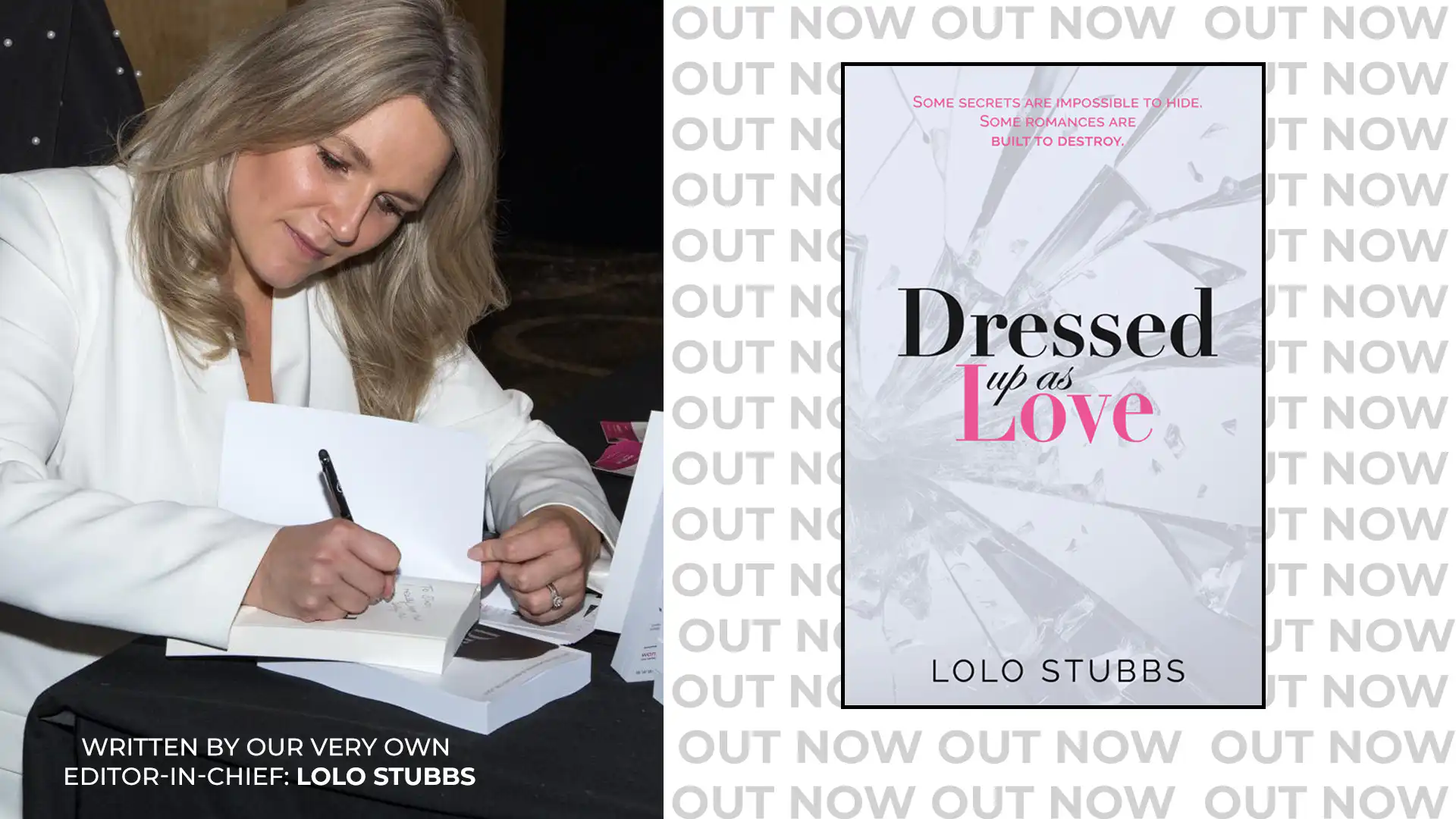
The impact endometriosis has had on my life is heavier than I think I even allow myself to fully admit. It started when I was 17. I was working as a nursery nurse, and I’d regularly collapse on the floor at work, in so much pain I couldn’t stay upright. I’d keep spare uniforms at the ready, and I was constantly dropping off extra pads because I bled so heavily I’d leak no matter how often I changed my tampons and pads. It was humiliating, exhausting, and frightening — and it quickly became my “normal”.
Then came the years of being in and out of hospital. The excruciating back pain. The times I’d lose the use of my legs around my period. And still, no diagnosis.
I spent five years dealing with infertility, being told there was only an 8% chance my husband and I would ever have children. I hadn’t even been diagnosed then either. Looking back, one of the hardest parts was the constant feeling that I was going mad — like I was exaggerating, like I wasn’t being believed, like the pain couldn’t possibly be as bad as I said it was.
Eventually, after five years of longing, I fell pregnant. I had my little boy, and when he was eight months old, I was pregnant again — this time with my little girl. But after she was born, I bled pretty much every day for six months. That’s when they did another laparoscopy. When I woke up from surgery, I was told they’d found and treated a significant amount of endometriosis. But endo didn’t stop there.
I went on to have two more pregnancies, and during my fourth pregnancy, they found a mass on a scan. I was told I needed to terminate the pregnancy, and I was put nil by mouth. I refused. I needed a second opinion. I was transferred to Liverpool Women’s Hospital, where they confirmed the mass wasn’t directly harming the baby — there was no need to terminate.
As the baby grew and pressed on the mass, I collapsed and was admitted to the hospital. After four weeks of extreme pain and being completely bed-bound, they decided they needed to deliver my baby seven weeks early.
I don’t think I understood how traumatic it would be to have a baby in NICU. The surgery itself was terrifying too, because they didn’t know whether the mass had a blood supply — and whether I was at risk of bleeding out.
It turned out the thing causing all the trouble was an endometrioma that had grown with each cycle between my third and fourth baby.
My latest scan showed my stomach, womb, bladder and bowel are stuck together, attached to my C-section scar. I’ve been waiting for surgery for years. I’m petrified of having it, but the stomach and back pain I get can be so debilitating. I’m in pain every day. Some days it knocks me off my feet — literally.
Endometriosis doesn’t just hurt. It takes pieces of your life, quietly and repeatedly. It’s a constant battle to feel well, and you have to fight endlessly for your own body — and for someone to finally listen.
– Lolo Stubbs, Endo Warrior, Editor-in-Chief, Author & Mum of Four
[/et_pb_text][et_pb_divider _builder_version=”4.27.4″ _module_preset=”default” global_colors_info=”{}”][/et_pb_divider][et_pb_code _builder_version=”4.27.5″ _module_preset=”default” hover_enabled=”0″ global_colors_info=”{}” sticky_enabled=”0″]
Links
[/et_pb_text][/et_pb_column][et_pb_column type=”1_2″ _builder_version=”4.16″ global_colors_info=”{}”][et_pb_text _builder_version=”4.16″ header_6_font=”Montserrat|700||on|||||” header_6_line_height=”1.8em” custom_margin=”||10px||false|false” locked=”off” global_colors_info=”{}”]
Follow Us
[/et_pb_text][et_pb_social_media_follow icon_color=”#FFFFFF” _builder_version=”4.27.5″ _module_preset=”default” custom_button=”on” button_font=”Montserrat|||on|||||” text_orientation=”center” custom_margin=”4px|-41px|4px|-41px||” custom_padding=”9px|68px|9px|48px||” global_module=”100570″ saved_tabs=”all” global_colors_info=”{}”][et_pb_social_media_follow_network social_network=”instagram” url=”https://www.instagram.com/broodmagazine” _builder_version=”4.20.2″ _module_preset=”default” background_color=”#ea2c59″ global_colors_info=”{}” follow_button=”off” url_new_window=”on”]instagram[/et_pb_social_media_follow_network][et_pb_social_media_follow_network social_network=”facebook” url=”https://www.facebook.com/broodmagazine” _builder_version=”4.16″ _module_preset=”default” background_color=”#3b5998″ global_colors_info=”{}” follow_button=”off” url_new_window=”on”]facebook[/et_pb_social_media_follow_network][et_pb_social_media_follow_network social_network=”linkedin” url=”http://www.linkedin.com/company/brood-magazine” _builder_version=”4.16″ _module_preset=”default” background_color=”#007bb6″ global_colors_info=”{}” follow_button=”off” url_new_window=”on”]linkedin[/et_pb_social_media_follow_network][et_pb_social_media_follow_network social_network=”twitter” url=”https://www.twitter.com/broodmagazine1″ _builder_version=”4.22.2″ _module_preset=”default” background_color=”#000000″ global_colors_info=”{}” follow_button=”off” url_new_window=”on”]twitter[/et_pb_social_media_follow_network][et_pb_social_media_follow_network social_network=”tiktok” url=”https://www.tiktok.com/@broodmagazine” _builder_version=”4.16″ _module_preset=”default” background_color=”#fe2c55″ global_colors_info=”{}” follow_button=”off” url_new_window=”on”]tiktok[/et_pb_social_media_follow_network][et_pb_social_media_follow_network social_network=”youtube” url=”https://www.youtube.com/channel/UCzLh30eP7Tvcys8O6NG3LDA” _builder_version=”4.16″ _module_preset=”default” background_color=”#a82400″ global_colors_info=”{}” follow_button=”off” url_new_window=”on”]youtube[/et_pb_social_media_follow_network][/et_pb_social_media_follow][/et_pb_column][/et_pb_row][/et_pb_section]