[et_pb_section fb_built=”1″ _builder_version=”4.16″ _module_preset=”default” global_colors_info=”{}” theme_builder_area=”post_content”][et_pb_row _builder_version=”4.16″ _module_preset=”default” custom_padding=”|||14px||” global_colors_info=”{}” theme_builder_area=”post_content”][et_pb_column type=”4_4″ _builder_version=”4.16″ _module_preset=”default” global_colors_info=”{}” theme_builder_area=”post_content”][et_pb_text _builder_version=”4.27.4″ _module_preset=”default” custom_padding=”9px|24px|24px|23px||” hover_enabled=”0″ global_colors_info=”{}” theme_builder_area=”post_content” sticky_enabled=”0″]
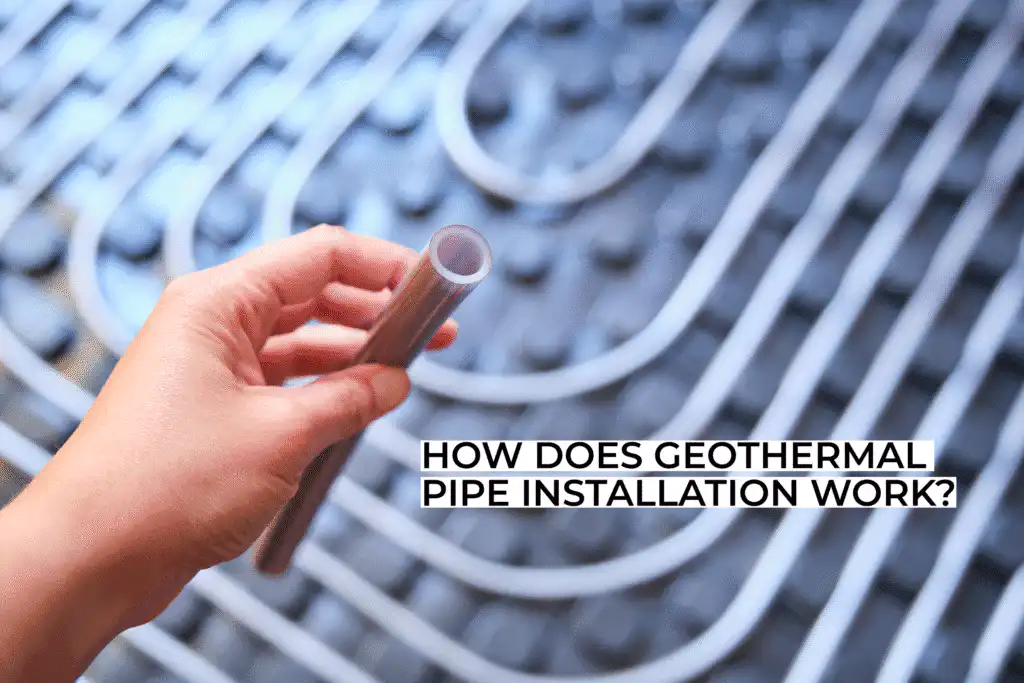
How does geothermal pipe installation work?
Over the past few years, heat pumps have shot up in popularity. Especially in the context of rising natural gas prices, they’re becoming increasingly attractive for a lot of home and business owners, thanks to their impressive efficiency and stable comparative costs.
That being said, a lot of people are keen to know a little more about how these systems work, and rightly so. Here, we take a look at how geothermal pipes, a central component of ground source heat pumps, are installed, to give you a better insight into how your installation might go.
What is a geothermal pipe?
Heat pumps might seem magic, but they’re not – they ‘simply’ take heat from the surrounding environment, and channel it into your home. Ground source heat pumps, in particular, take that energy from the earth below, and there are two different ways that this energy is transferred.
Horizontal pipes
Horizontal geothermal pipes, as you might expect, lie horizontally to the surface of the ground. To install them, you dig a trench of around 4-6 feet in depth. Then, two pipes are buried – one at around 6 feet depth, the other at 4 feet depth.
These two pipes are then connected to the heating/cooling system, so that liquid can be put through them. These kinds of approaches are more common for domestic applications, where not a lot of pipe is required for heating purposes.
[/et_pb_text][et_pb_image src=”https://broodmagazine.com/wp-content/uploads/2025/11/two-efficient-outdoor-heat-pump-units-placed-in-fr-2025-03-12-22-31-29-utc-scaled.webp” alt=”Heat Pump Installation” title_text=”Two efficient outdoor heat pump units placed in front of the house.” _builder_version=”4.27.4″ _module_preset=”default” custom_padding=”||6px|||” hover_enabled=”0″ global_colors_info=”{}” theme_builder_area=”post_content” sticky_enabled=”0″][/et_pb_image][et_pb_divider _builder_version=”4.27.4″ _module_preset=”default” custom_margin=”-19px||3px|||” global_colors_info=”{}” theme_builder_area=”post_content”][/et_pb_divider][et_pb_code _builder_version=”4.27.4″ _module_preset=”default” custom_padding=”0px|||||” global_colors_info=”{}” theme_builder_area=”post_content”]

[/et_pb_code][et_pb_divider _builder_version=”4.27.4″ _module_preset=”default” custom_margin=”||6px|||” global_colors_info=”{}” theme_builder_area=”post_content”][/et_pb_divider][et_pb_text _builder_version=”4.27.4″ _module_preset=”default” custom_padding=”9px|24px|24px|23px||” hover_enabled=”0″ global_colors_info=”{}” theme_builder_area=”post_content” sticky_enabled=”0″]
Vertical pipes
With vertical installations, instead of being laid horizontally, the pipes will be laid vertically. To do this, deep holes will be bored by a service like Teckna Group in the ground, between 100 – 400 feet deep, into which the pipe can then be threaded.
These kinds of approaches are more common for larger, commercial buildings, where the area of land required to heat or cool the premises in question would be too much, and drilling boreholes becomes more efficient.
How is the energy transferred?
Once the water/anti-freeze mixture has been circulated through the pipes, it will arrive at a heat exchange that has been installed on the premises in question. Here, the water/anti-freeze is used to slightly heat a heat transfer fluid (called refrigerant) in a separate, sealed part of the heat exchange so that it begins to boil and turns into a gas.
The gas is put into a compressor, and as the pressure is increased by the compressor, the gas gets hotter. That gas then goes into another heat exchanger called a condenser, which is essentially the same as the first one.
The condenser heats up water, which can then be used for heating purposes and for mains water use. Now that the gas has transferred its energy, it turns into a liquid again and restarts the cycle.
Ground source heat pumps are a bit confusing, but this should have hopefully cleared things up a bit – at least in terms of how the pipe is laid underground. If you’re not sure which method to use, speak with an installation expert, and they’ll be able to suggest the one that’s best suited to your needs.
[/et_pb_text][/et_pb_column][/et_pb_row][/et_pb_section][et_pb_section fb_built=”1″ admin_label=”Related Articles” _builder_version=”4.16″ global_colors_info=”{}” theme_builder_area=”post_content”][et_pb_row _builder_version=”4.27.4″ _module_preset=”default” global_colors_info=”{}” theme_builder_area=”post_content”][et_pb_column type=”4_4″ _builder_version=”4.27.4″ _module_preset=”default” global_colors_info=”{}” theme_builder_area=”post_content”][et_pb_divider _builder_version=”4.27.4″ _module_preset=”default” custom_margin=”||8px|||” global_colors_info=”{}” theme_builder_area=”post_content”][/et_pb_divider][et_pb_code _builder_version=”4.27.4″ _module_preset=”default” hover_enabled=”0″ global_colors_info=”{}” theme_builder_area=”post_content” sticky_enabled=”0″]
[/et_pb_code][et_pb_code _builder_version=”4.27.4″ _module_preset=”default” global_colors_info=”{}” theme_builder_area=”post_content”]

[/et_pb_code][et_pb_divider divider_weight=”5px” _builder_version=”4.27.4″ _module_preset=”default” global_colors_info=”{}” theme_builder_area=”post_content”][/et_pb_divider][et_pb_image src=”https://broodmagazine.com/wp-content/uploads/2025/02/the-latest-from-brood.webp” title_text=”the latest from brood” _builder_version=”4.27.4″ _module_preset=”default” global_colors_info=”{}” theme_builder_area=”post_content”][/et_pb_image][et_pb_blog include_categories=”67″ _builder_version=”4.27.4″ _module_preset=”default” custom_padding=”30px|12px||12px||” global_colors_info=”{}” theme_builder_area=”post_content”][/et_pb_blog][/et_pb_column][/et_pb_row][/et_pb_section][et_pb_section fb_built=”1″ admin_label=”Footer” _builder_version=”4.16″ background_color_gradient_direction=”90deg” custom_padding=”0px||100px||false|false” box_shadow_style=”preset7″ box_shadow_horizontal=”0px” box_shadow_vertical=”-180px” box_shadow_color=”#ffffff” locked=”off” global_colors_info=”{}” theme_builder_area=”post_content”][et_pb_row column_structure=”1_2,1_2″ custom_padding_last_edited=”on|phone” admin_label=”Row” _builder_version=”4.16″ background_enable_color=”off” z_index=”10″ width_tablet=”” width_phone=”90%” width_last_edited=”on|phone” custom_margin=”-1px|auto||auto|false|false” custom_margin_tablet=”0px||||false|false” custom_margin_phone=”” custom_margin_last_edited=”on|desktop” custom_padding=”5px|50px|0px|50px|false|true” custom_padding_tablet=”|10%||0px|false|false” custom_padding_phone=”|5%||5%|false|true” box_shadow_style=”preset4″ box_shadow_horizontal=”30vw” box_shadow_vertical=”0px” box_shadow_color=”#000000″ box_shadow_color_tablet=”#ffc077″ box_shadow_color_last_edited=”off|tablet” global_colors_info=”{}” theme_builder_area=”post_content”][et_pb_column type=”1_2″ _builder_version=”4.16″ global_colors_info=”{}” theme_builder_area=”post_content”][et_pb_text ul_type=”none” ul_item_indent=”1px” _builder_version=”4.16″ link_text_color=”#000000″ ul_line_height=”2.4em” header_6_font=”Montserrat|700||on|||||” header_6_line_height=”1.8em” custom_padding=”|||13px||” global_colors_info=”{}” theme_builder_area=”post_content”]
Links
[/et_pb_text][/et_pb_column][et_pb_column type=”1_2″ _builder_version=”4.16″ global_colors_info=”{}” theme_builder_area=”post_content”][et_pb_text _builder_version=”4.16″ header_6_font=”Montserrat|700||on|||||” header_6_line_height=”1.8em” custom_margin=”||10px||false|false” locked=”off” global_colors_info=”{}” theme_builder_area=”post_content”]
Follow Us
[/et_pb_text][et_pb_social_media_follow icon_color=”#FFFFFF” _builder_version=”4.27.4″ _module_preset=”default” custom_button=”on” button_font=”Montserrat|||on|||||” text_orientation=”left” custom_margin=”4px|-41px|4px|-41px||” custom_padding=”9px|68px|9px|48px||” global_module=”100570″ saved_tabs=”all” global_colors_info=”{}” theme_builder_area=”post_content”][et_pb_social_media_follow_network social_network=”instagram” url=”https://www.instagram.com/broodmagazine” _builder_version=”4.20.2″ _module_preset=”default” background_color=”#ea2c59″ global_colors_info=”{}” theme_builder_area=”post_content” follow_button=”off” url_new_window=”on”]instagram[/et_pb_social_media_follow_network][et_pb_social_media_follow_network social_network=”facebook” url=”https://www.facebook.com/broodmagazine” _builder_version=”4.16″ _module_preset=”default” background_color=”#3b5998″ global_colors_info=”{}” theme_builder_area=”post_content” follow_button=”off” url_new_window=”on”]facebook[/et_pb_social_media_follow_network][et_pb_social_media_follow_network social_network=”linkedin” url=”http://www.linkedin.com/company/brood-magazine” _builder_version=”4.16″ _module_preset=”default” background_color=”#007bb6″ global_colors_info=”{}” theme_builder_area=”post_content” follow_button=”off” url_new_window=”on”]linkedin[/et_pb_social_media_follow_network][et_pb_social_media_follow_network social_network=”twitter” url=”https://www.twitter.com/broodmagazine1″ _builder_version=”4.22.2″ _module_preset=”default” background_color=”#000000″ global_colors_info=”{}” theme_builder_area=”post_content” follow_button=”off” url_new_window=”on”]twitter[/et_pb_social_media_follow_network][et_pb_social_media_follow_network social_network=”tiktok” url=”https://www.tiktok.com/@broodmagazine” _builder_version=”4.16″ _module_preset=”default” background_color=”#fe2c55″ global_colors_info=”{}” theme_builder_area=”post_content” follow_button=”off” url_new_window=”on”]tiktok[/et_pb_social_media_follow_network][et_pb_social_media_follow_network social_network=”youtube” url=”https://www.youtube.com/channel/UCzLh30eP7Tvcys8O6NG3LDA” _builder_version=”4.16″ _module_preset=”default” background_color=”#a82400″ global_colors_info=”{}” theme_builder_area=”post_content” follow_button=”off” url_new_window=”on”]youtube[/et_pb_social_media_follow_network][/et_pb_social_media_follow][/et_pb_column][/et_pb_row][/et_pb_section]