
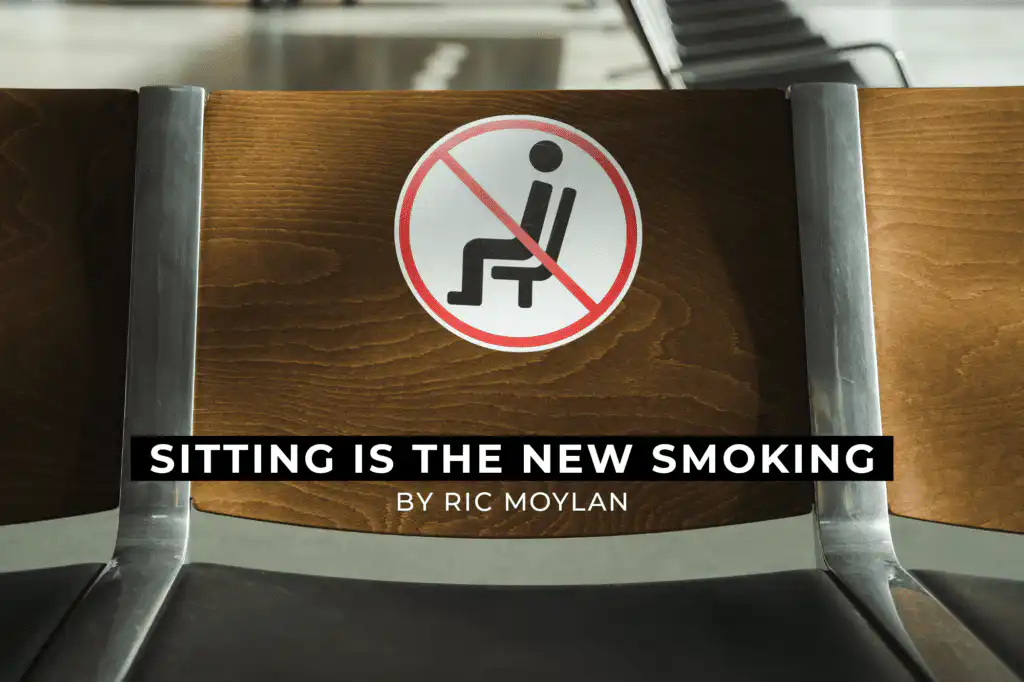
Sitting is the new smoking
Sitting Is The New Smoking
[/et_pb_text][/et_pb_column][/et_pb_row][et_pb_row column_structure=”1_2,1_2″ _builder_version=”4.19.3″ _module_preset=”default” custom_padding=”8px|||14px||” global_colors_info=”{}”][et_pb_column type=”1_2″ _builder_version=”4.16″ _module_preset=”default” global_colors_info=”{}”][et_pb_text content_tablet=”Sitting is the new smoking
By Ric Moylan
The landscape of life changed in 2020 in many areas due to the Covid 19 Pandemic that swept across the globe. There were a number of different situations and circumstances that were classified as ‘the new normal’ and working from home was most certainly one of them.
Some of these new normals were just a short-term requirement (thankfully), whereas others such as working from home have remained. Now I don’t know about you, but prior to 2020 working from home was something that I had never considered or ever done. Zoom or Teams, what were they?!
Putting aside that perhaps I was a bit of a dinosaur, research has shown that working from home offers several health benefits, which can positively impact both physical and mental well-being.
These include: –
The potential for better nutrition intake
Improved sleep
Increased physical activity (hmmm I’m not so sure about this)
A comfortable work environment
Reduced stress due to less commute time
Better work-life balance
Increased productivity
More family time
Ability to take breaks as needed
Decreased social anxiety
As is often the case however, there is also counter research that has stated that whilst working from home does offer many benefits, it can also present several challenges and potential negative effects on both physical and mental health.
Some of these include:
An increased sedentary lifestyle (let’s talk a little more about this)
Poor ergonomics (and this!)
Increased screen time leading to digital eye strain/computer vision syndrome, headaches, blurred vision, and dry eyes
Isolation and loneliness
Stress and burnout
Presenteeism
Distractions and lack of focus
Reduced social interaction
Communication challenges
Technology issues
Lack of access to resources
” content_phone=”
Sitting is the new smoking
By Ric Moylan
The landscape of life changed in 2020 in many areas due to the Covid 19 Pandemic that swept across the globe. There were a number of different situations and circumstances that were classified as ‘the new normal’ and working from home was most certainly one of them.
Some of these new normals were just a short-term requirement (thankfully), whereas others such as working from home have remained. Now I don’t know about you, but prior to 2020 working from home was something that I had never considered or ever done. Zoom or Teams, what were they?!
Putting aside that perhaps I was a bit of a dinosaur, research has shown that working from home offers several health benefits, which can positively impact both physical and mental well-being.
These include: –
The potential for better nutrition intake
Improved sleep
Increased physical activity (hmmm I’m not so sure about this)
A comfortable work environment
Reduced stress due to less commute time
Better work-life balance
Increased productivity
More family time
Ability to take breaks as needed
Decreased social anxiety
As is often the case however, there is also counter research that has stated that whilst working from home does offer many benefits, it can also present several challenges and potential negative effects on both physical and mental health.
Some of these include:
An increased sedentary lifestyle (let’s talk a little more about this)
Poor ergonomics (and this!)
Increased screen time leading to digital eye strain/computer vision syndrome, headaches, blurred vision, and dry eyes
Isolation and loneliness
Stress and burnout
Presenteeism
Distractions and lack of focus
Reduced social interaction
Communication challenges
Technology issues
Lack of access to resources
” content_last_edited=”off|desktop” _builder_version=”4.27.3″ _module_preset=”default” custom_padding=”26px|24px||24px||” hover_enabled=”0″ global_colors_info=”{}” sticky_enabled=”0″]
By Ric Moylan
The landscape of life changed in 2020 in many areas due to the Covid 19 Pandemic that swept across the globe. There were a number of different situations and circumstances that were classified as ‘the new normal’ and working from home was most certainly one of them.
Some of these new normals were just a short-term requirement (thankfully), whereas others such as working from home have remained. Now I don’t know about you, but prior to 2020 working from home was something that I had never considered or ever done. Zoom or Teams, what were they?!
[/et_pb_text][/et_pb_column][et_pb_column type=”1_2″ _builder_version=”4.16″ _module_preset=”default” global_colors_info=”{}”][et_pb_image src=”https://broodmagazine.com/wp-content/uploads/2024/07/TP18318-copy-2.webp” alt=”Helen Skelton” title_text=”_TP18318 copy 2″ _builder_version=”4.27.0″ _module_preset=”default” custom_margin=”||11px|||” custom_padding=”24px|15px|12px|15px||” global_colors_info=”{}”][/et_pb_image][/et_pb_column][/et_pb_row][/et_pb_section][et_pb_section fb_built=”1″ fullwidth=”on” _builder_version=”4.23.4″ _module_preset=”default” global_colors_info=”{}”][et_pb_fullwidth_code _builder_version=”4.23.4″ _module_preset=”default” custom_padding=”||26px|||” global_colors_info=”{}”]

Putting aside that perhaps I was a bit of a dinosaur, research has shown that working from home offers several health benefits, which can positively impact both physical and mental well-being.
These include: –
The potential for better nutrition intake
Improved sleep
Increased physical activity (hmmm I’m not so sure about this)
A comfortable work environment
Reduced stress due to less commute time
Better work-life balance
Increased productivity
More family time
Ability to take breaks as needed
Decreased social anxiety
As is often the case however, there is also counter research that has stated that whilst working from home does offer many benefits, it can also present several challenges and potential negative effects on both physical and mental health.
Some of these include:
An increased sedentary lifestyle (let’s talk a little more about this)
Poor ergonomics (and this!)
Increased screen time leading to digital eye strain/computer vision syndrome, headaches, blurred vision, and dry eyes
Isolation and loneliness
Stress and burnout
Presenteeism
Distractions and lack of focus
Reduced social interaction
Communication challenges
Technology issues
Lack of access to resources
Potential for decreased professional development
I must state that the purpose of this article is not to sway opinion on whether I believe that working from home is a good or bad thing or should or shouldn’t happen. I am also as always certainly not here to judge.
What I do personally believe (whether this is caused by increased working from home or not) is that quite simply we are moving less than we ever have, and spending more time sat on our lovely backsides than we also ever have. Both our movement volume and movement quality are at an all-time low. When given the choice whether to jump in a lift or on an escalator or take the stairs, data from the USA states that only 2% of people will take the stairs (Easter., 2021). This is backed by further research showing that we exercise 14 x less than our ancestors – who moved fast for 2 hours daily (O’Keefe et al., 2010). For context, we’re living in a world where some people don’t even go to collect their take aways anymore!! It’s a slippery slope, it’s only getting worse, and this is causing major problems to both our physical and mental health. So much so, that statistically, the links to long-term sitting down and poor health issues show that:
[/et_pb_text][et_pb_image src=”https://broodmagazine.com/wp-content/uploads/2024/11/woman-video-chatting-from-her-living-room-2024-11-16-12-13-14-utc.webp” alt=”large lady working from home” title_text=”A woman sits on the floor in front of a couch, using a laptop to” _builder_version=”4.27.3″ _module_preset=”default” custom_padding=”17px|13px||19px||” hover_enabled=”0″ global_colors_info=”{}” sticky_enabled=”0″][/et_pb_image][et_pb_text _builder_version=”4.27.3″ _module_preset=”default” custom_padding=”13px|24px|15px|24px||” hover_enabled=”0″ global_colors_info=”{}” sticky_enabled=”0″]SITTING IS THE NEW SMOKING.
Yes, you read that right.
And that is frightening.
Long-term sitting down is now linked to more chronic illness and ill health such as heart disease, lung disease, diabetes etc than smoking is.
- People who spend more than 6 hours per day sitting with low levels of physical activity have a 71% increase in mortality rate.
- Sitting for more than 7 hours daily increases the risk of depression by 47% compared to those who only sit for 4 hours a day or less.
(Chau et al., 2013)
- A sedentary lifestyle can increase the risk of developing Alzheimer’s by up to 12 times.
(Yan et al., 2020)
And I could carry on.
Whether you like it or not, or even realise it or not, long-term sitting down is destroying your health, is ruining your body, and the decline is frightening and dramatic especially as each year passes by.
With reduced physical mobility you get higher rates of disease, as well as increases in disability, hospitalization, and an early visit to your maker – the data shows that society is literally sitting itself to death!!!
From a musculoskeletal perspective, the damage is extremely evident. Recent studies show that we have less mobility and range of motion in our joints than we ever have, and this is playing havoc and causing increased pain in our back, hips, shoulders and knee joints. It’s causing increased sarcopenia (muscle and strength loss), and again it only gets worse with age.
Poor levels of mobility are also directly linked to low levels of performance. With poor mobility, you will perform worse in the gym, in your sports, and in the workplace. Your body will overwork potentially leading to fatigue and or injury. Basically put, in every area, you will have a poorer quality of life.
Now I’m sorry to be all doom and gloom.
But we must accept that this part of our lifestyle is doing us no favours at all. The good news, however, is that you can do something about it, and you must start getting yourself moving more today to undo this.
Because, as the saying goes: –
Movement is medicine.
I can testify to this as I have personal experience of the damage that too much sitting and a lack of the correct and specific movements each day can cause. This is not because of the thousands of clients I have worked with, from beginner right through to elite athlete. This is a journey I am all too familiar with. You see, due to Covid-19 a lot more of my work and daily life had transferred to Zoom and being sat on my laptop. Meetings and seminars that were in person went virtual, face to face coaching sessions where I would often take clients walking and in the outdoors were exchanged for the screen, and I spent far more time sitting down than I ever had. After ignoring some warning signs, I developed a pretty serious injury in my lower back and was diagnosed that I had ‘slipped a disc’.
I don’t mind telling you, it was absolute agony.
Basic functions such as walking a few steps, tying my shoelaces, picking my bag up off the floor and even going to the toilet (!!!) were almost impossible. They were extremely painful if nothing else. Whilst of course these things can occasionally happen, I’d love to tell you that my injury and subsequent severe pain couldn’t have been avoided, but it’s likely that it could. You see I was aware that my posture and overall mobility had been poor for a number of years, and I was also aware that this was causing me discomfort at times in my life. But it ‘wasn’t too bad’, so if I’m honest, I ignored it.
Slowly and steadily, I had developed what is known as ‘Lower Crossed Syndrome’. This presents as having an anterior (forward) pelvic tilt, tightness in the hip flexors, and weakness in the gluteal muscles (Sahu & Phansopkar., 2021). I suppose you could say that my arch in my back was noticeable, and my posture looked a little bit like a duck!! And you guessed it, this condition is caused by inactivity, too much sitting down, and is linked and known to cause pain in a variety of areas, especially chronic and intense pain in the lower back! Sadly, the statistics show that Lower Crossed Syndrome, the symptoms of this, the pain especially in the lower back, and the posture this makes your body look like (duck posture) may be familiar to some of you?
So, what must you do about it??
A quick Google search about tips to counterbalance increased inactivity and too much sitting down will tell you to:
- Stay active
- Maintain a routine
- Eat healthy
- Get your 10,000 steps in each day etc.
And all of that is absolutely correct. But you must go further and focus on specific work to improve your mobility, posture, and undo the effects of inactivity and long-term sitting. This work can be a little painful,** it can most certainly be boring, but you must make it a priority and do it every single day. It’s also likely that you will do this work for the rest of your life.
You should work on all joints and muscles within your body, however a saying I came across many years ago is that “the hips are the bully of the body” and this is true with your mobility. You must target the hips, in particularly the psoas major (known as hip flexors) and work on them directly. When tightened the psoas muscles begin to “bully” other areas of the body. The pelvis tilts forwards, your core strength is reduced, your glute strength is reduced, the discs in the lower back are compressed amongst other things, and the journey towards being in pain begins.
Stretching alone will not do the trick to fix you. You must attend and perform Pilates based exercises, and include strengthening exercises such as glute bridges, with rear elevated split squats being the leading exercise to reverse these negative effects. Remember, you should perform these under supervision if you have not done them previously.
The final challenge is your focusing on your mindset. Being in pain is debilitating and can affect your mood, and you must be aware of this. Again, remember that movement is medicine. Make a commitment to start and end your day with some mobility and strength-based work, and you will soon start to feel much better both physically and mentally. I’ve already mentioned that the corrective movements and exercises can be boring and will often provide very minimal instant reward or muscular feedback (they often hurt, and you don’t always get that ‘pump’ or training high). Being aware of this will help. Instead of seeking the short-term pleasure ‘feeling’ associated with training, commit to a personal code of completing your mobility and postural based exercises every day whether you feel like it or not. Focus on the long-term gains, instead of the short-term quick fixes and commit to intentional and correctional movements every day.
Get out of the chair, and off the sofa. Mobilise the tight areas in your body and strengthen the weaker areas. Every day, prioritise the micro tasks that are so effective such as sitting on the floor, on an exercise ball, on in a deep squat position as often as you can.
Be mindful of the stories you tell yourself, about yourself. You are not lacking in mobility or strength because of age, or because you are ‘getting older’. It is not a done deal, and it is not too late. Your body is tight, weak and in pain because you are not doing enough of what your body is designed to do, and that is purposeful and intentional movement each and every day.
It’s time to take responsibility for this and it’s time to change.
So that with the gift of age, you will not just ‘cope’ or survive, but instead, physically and mentally, you will thrive.
Best wishes.
Ric
*Always consult a qualified physician or doctor before participating in any form of physical activity.
[/et_pb_text][et_pb_code _builder_version=”4.27.0″ _module_preset=”default” global_colors_info=”{}”]