5 Easter Chemistry Experiments for Families to Try at Home
5 Easter Chemistry Experiments for Families to Try at Home
As the Easter school holidays get underway, the Royal Society of Chemistry (RSC) has released five egg-citing chemistry experiments for families to try at home, allowing them to discover the science hidden in everyday life through fun and colourful activities.
Using common household items, children can explore everything from chemical reactions to colour separation and material changes through a series of Easter-themed experiments, designed to spark a love of science in curious young minds.
Ross Christodoulou, Education Coordinator at the Royal Society of Chemistry, said: “Easter is the perfect time to let curiosity hatch. These simple experiments turn everyday ingredients into little bursts of chemistry fun: from swirling colours to sparkling crystals. You don’t need a lab coat to explore science with your family; just a sense of play and a willingness to get a bit messy!”
The simple, family-friendly activities reveal the science behind colour, materials and reactions. Whether it’s swirling milk, growing glittering crystals or uncovering hidden messages, each experiment offers children a chance to explore chemistry through curiosity and play – no laboratory required.
The RSC’s top five chemistry experiments to try at home this Easter are:
1. Make art from milk: discover the science behind colour by using chemistry to create dramatic, colourful swirls in milk
You will need:
- A shallow dish
- Whole milk
- Food colouring
- Washing-up liquid
- Cotton buds
Instructions:
- Pour enough milk into the dish to cover the bottom.
- Add a few drops of different food colourings around the milk.
- Dip a cotton bud into washing-up liquid.
- Touch the surface of the milk with the soapy bud and watch the colours swirl.
- Try again in different spots to create new patterns.
The chemistry:
Milk contains proteins and fat droplets suspended in water. Soap molecules attach to fats and disrupt their structure. As the soap spreads through the milk, it pushes the surrounding liquid, including the food colouring, causing the dramatic swirling motion. This visualises surfactant-fat interactions happening on a molecular level.
2. Make your eggs shine: learn about natural mineral formation by growing your own ‘crystal eggs’
You will need:
- Clean, empty eggshell halves or small jars
- Table salt or Epsom salts
- Warm water
- A spoon
- Food colouring (optional)
Instructions:
- Fill a cup with warm water.
- Add salt, one spoonful at a time, stirring continuously until no more dissolves — this is a saturated solution.
- Add a drop of food colouring if you want coloured crystals.
- Pour the solution into the eggshell halves or jars.
- Leave undisturbed for 12–48 hours.
- Watch as sparkling crystals form on the inside surfaces.
The chemistry:
Warm water can dissolve more salt than cold water. As the solution cools and gradually evaporates, it becomes too concentrated to hold all the dissolved salt. The excess salt molecules begin to bond together in repeating geometric patterns — forming crystals. This is similar to natural mineral formation in caves and rocks.
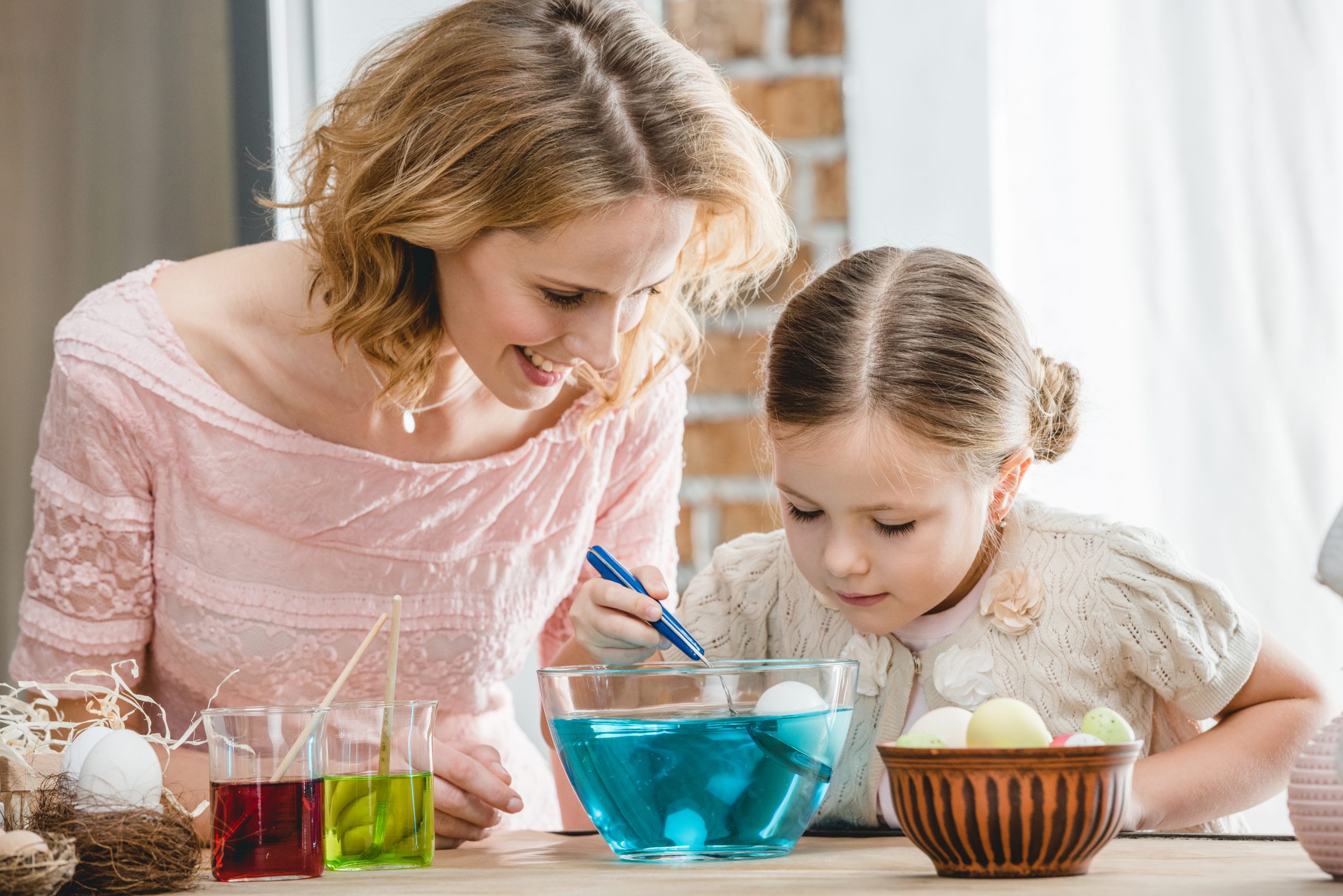
3. Leave hidden messages on eggs for your family to crack: inspire curiosity about acidic reactions by dyeing eggs
You will need:
- Hard-boiled eggs
- Lemon juice
- Cotton buds or a fine paintbrush
- Food colouring or natural dyes
- A cup of warm water
Instructions:
- Dip a cotton bud into lemon juice.
- Write or draw on the eggshell with the lemon juice.
- Allow the egg to dry completely.
- Prepare a cup of dye (food colouring in warm water).
- Submerge the egg for a few minutes.
- Lift it out to reveal your hidden design, which will appear lighter than the surrounding shell.
The chemistry:
Eggshells are made largely of calcium carbonate. Lemon juice contains citric acid, which gently reacts with and etches the shell. When the egg is dyed, the etched areas absorb less pigment. This difference reveals the pattern. It’s a mild demonstration of an acid–carbonate reaction: the same type of chemistry that creates fizzing when acids meet bicarbonate of soda.

4. Hatch a ‘rubber egg’: see osmosis in action by making a bouncy, stretchy egg
You will need:
- A raw egg
- A glass or jar
- Vinegar
Instructions:
- Place the raw egg carefully into the glass.
- Cover it completely with vinegar.
- Leave for 24–48 hours.
- Observe bubbles forming on the shell.
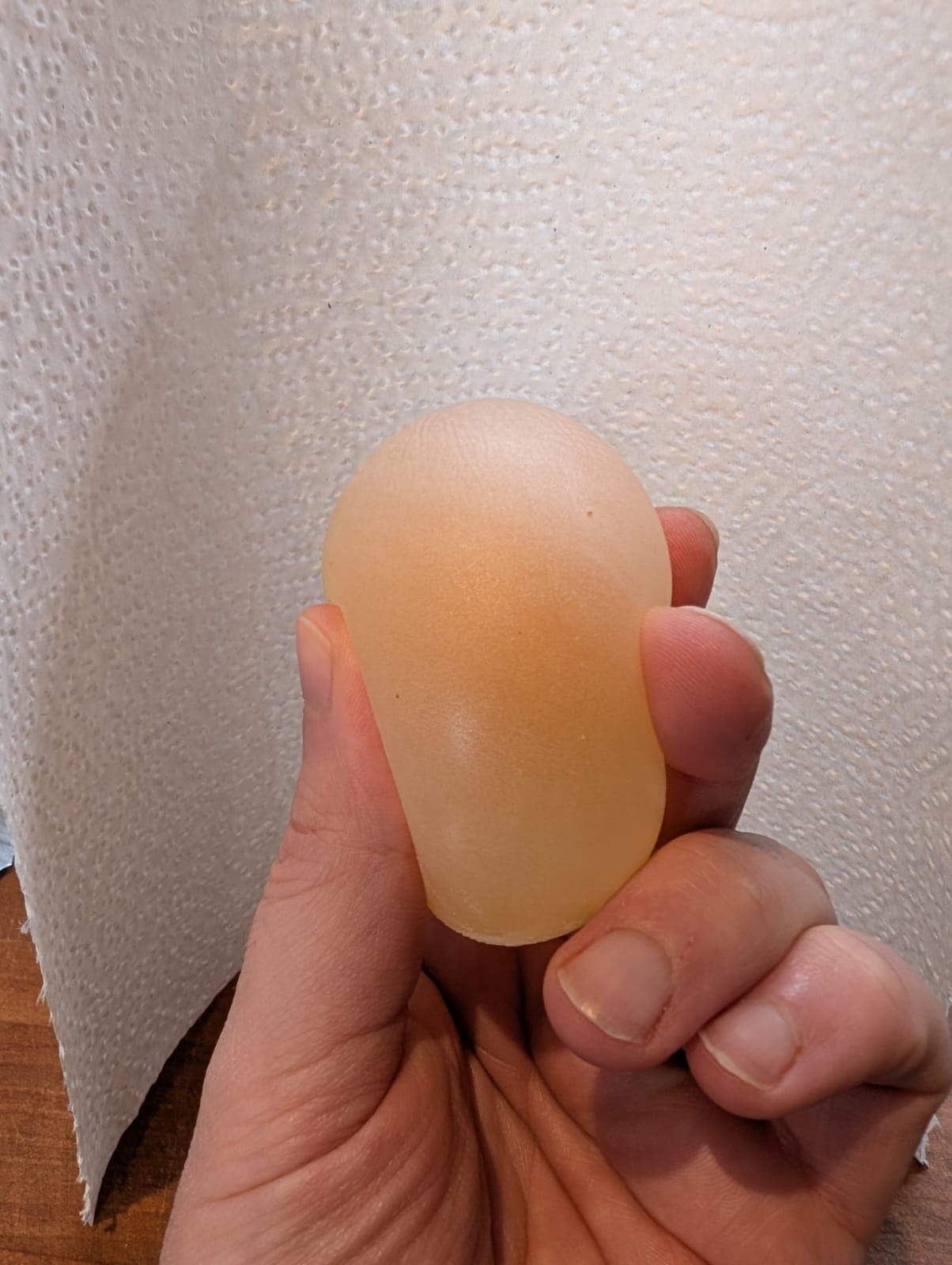
- After a day or two, gently rinse the egg under water. The shell should have dissolved, leaving a bouncy, stretchy egg.
The chemistry:
Vinegar contains acetic acid, which reacts with calcium carbonate in the eggshell to produce carbon dioxide gas (visible as bubbles). This dissolves the shell entirely. The inner membrane remains intact. It is semi-permeable, allowing water to move into the egg, often causing it to swell — a demonstration of osmosis.
5. Watch your mini eggs leave a colourful trail: separate mixtures using chromatography, a common method used in real labs every day
You will need:
- Mini eggs, smarties or similar coloured sweets
- Filter paper, coffee filters or kitchen roll
- A plate or tray
- Water
- Small bowls or lids
Instructions:
- Cut a strip of filter paper or coffee filter.
- Place the bottom edge of the paper into a shallow pool of water (use a lid or small dish).
- Place a sweet so that its shell just touches the damp paper.
- As the water climbs the paper, it dissolves the dye from the sweet and carries it upward.
- Watch as the colours separate into different bands.
The chemistry:
This is chromatography – a method used in real laboratories to separate mixtures. Water travels up the paper by capillary action. Food colourings all have different molecular properties. Some move more easily with water, others stick more to the paper fibres. As the water moves, these differences cause colours to spread out and separate, revealing the individual dyes that made the original coating.
Safety Notes:
- Adult supervision recommended for all activities.
- Avoid eating materials after they’ve been mixed or used in experiments.
- Eggs used in the rubber-egg experiment are not edible.
- Protect surfaces and clothing from dyes and spills.
- Dispose of eggs and solutions responsibly.
For more information about the RSC, please visit: www.rsc.org


KEEP UP TO DATE WITH BROOD:
Related Articles

Back to School 2026: The Ultimate Kids’ Essentials & Parent Hacks
Back to School Special Back to School 2026: The Ultimate Kids’ Essentials & Parent Hacks From seamless uniform upgrades to smart tech that keeps kids focused and safe, here is our editorial edit for the new school term. Between sorting uniforms, replacing outgrown...

Why Learning a Language as a Busy Parent Is One of the Best Things You Can Do (And How to Actually Make It Happen)
Travel Why Learning a Language as a Busy Parent Is One of the Best Things You Can Do (And How to Actually Make It Happen) No classroom. No fixed timetable. Just you, a real tutor, and a skill that'll stick around for life. When was the last time you did something...

Ibiza Comes to London: Why the Alto x Cotton Beach Club Collab Belongs on Every Parent’s Night-Off List
Ibiza isn’t on the cards for most of us this summer — but that doesn’t mean you can’t get a taste of it. Alto by San Carlo has partnered with the iconic Cotton Beach Club Ibiza for two exclusive evenings on the rooftop of Selfridges, London. Think sun-soaked Mediterranean food, live DJ sets, Champagne and London’s skyline as your backdrop. Two dates only — and honestly? You deserve this one.

Lisa Johnson: From £30K Debt to Multi-Millionaire – How a Mum of Two Built a Freedom-Focused Business
Discover how Lisa Johnson, award-winning entrepreneur and mum of twins, went from £30,000 in debt to building a multi-million-pound business in just seven years. In this exclusive interview, Lisa shares her journey through adversity, her strategies for scaling with passive income, and her honest advice for parents and entrepreneurs seeking financial freedom, work-life balance, and lasting impact. Keywords: Lisa Johnson, entrepreneur, passive income, business strategy, work-life balance, financial freedom, mumpreneur, online business, success story.

School Holiday Jigsaw: Surviving the Summer Holidays as a Working Parent
School Holiday Jigsaw: Surviving the Summer Holidays as a Working Parent
For school children, the six-week break is a magical expanse of unstructured freedom. For working parents, it marks the beginning of a military-grade logistical operation. Between the skyrocketing costs of summer camps, tag-teaming annual leave with partners, and attempting the ultimate high-wire act of working from home with a laptop on your knee, the math of July and August simply doesn’t add up. We dive deep into the reality of trying to fit a 19th-century agricultural school calendar into a 21st-century digital economy—and explore the progressive workplace shifts needed to save our sanity.

The Cognitive Crutch: Are We Outsourcing Our kid’s Brains to AI?
The Cognitive Crutch: Are We Outsourcing Our Children’s Brains to AI?
Generative AI has transitioned from a novel tech trend to a permanent classroom fixture. But as tools like ChatGPT effortlessly handle the heavy cognitive lifting of writing essays and solving equations, educators and neuroscientists are raising an urgent alarm. True learning is rooted in the cognitive friction of arriving at an answer. By outsourcing that struggle to machines, are we causing intellectual stamina to atrophy, leaving behind a generation of brilliant curators who have lost the ability to think independently? From primary schools to university campuses, the data reveals a stark shift from active learning to passive “cognitive offloading.”

The Big 2026 British Playcation: The Ultimate Free, Low-Cost & Premium Summer Days Out
The six-week school summer holidays are here, but keeping kids entertained shouldn’t break the bank. With new data showing a massive “play gap” across the UK, we’ve rounded up 11 of the absolute best national initiatives, free community festivals, heavily discounted active-play passes, and premium family adventures to help you balance the budget while creating unforgettable summer memories.

Why the UK is Suddenly Going All Out for Graduation Season
Discover why British graduations are becoming massive lifestyle events and explore San Carlo’s new summer menu—the perfect way to celebrate in style.

New ‘xV’ Campaign Launches “The Unspoken Stat” to Expose Hidden Domestic Abuse Spike Around England Matches
A powerful new World Cup campaign introduces “xV” (Expected Violence) to expose a chilling reality: research shows domestic abuse incidents spike by 38% when England loses and 26% even when they win. Backed by survivors, sports figures, and celebrities like Mel B, the campaign demands that this hidden statistic receives the same urgent attention as modern football data.
Banning Social Media Under 16: What the New UK Law Means for Parents
The UK government has announced a landmark social media ban for children under 16. From affected apps to enforcement timelines, here is what the “Australia Plus” model means for busy working parents and family life.